How to Transfer Car Ownership in Pakistan
Note: Transfer fees and procedural requirements are set by provincial Excise and Taxation Departments and can change. The figures in this article reflect the most current publicly available information as of mid-2026. Always verify exact fees and documents with your local Excise office before visiting.
Selling a car in Pakistan and skipping the ownership transfer is one of the most common financial mistakes people make without realising it. The seller stays legally responsible for the vehicle until the transfer is formally completed. That means traffic fines, accidents, or even crimes involving the car can come back to you even after the sale.
Transferring car ownership in Pakistan is not complicated, but it does require both buyer and seller to show up at the right place with the right documents. This guide walks you through the complete process, province by province, along with the fees you’ll pay and what to watch out for when buying or selling a used car.
Why the Transfer Matters More Than Most People Think
Without a formal transfer, the seller would remain responsible for any future traffic violations, taxes, penalties, and so on related to the vehicle. The transfer of vehicle ownership is a legal function that formally transfers ownership rights from one party to another.
That’s not a theoretical risk. Cases of sellers receiving e-challans months after a sale, or being flagged in police databases for vehicles they no longer own, are documented and common in Pakistan’s used car market. For the buyer, driving a car that’s still registered in someone else’s name creates its own set of problems, including complications if the vehicle is stopped by traffic police or involved in an accident.
Get the transfer done as soon as possible after the sale. Don’t let the seller or buyer delay it.
Read: How to Check Vehicle Owner Details in Pakistan
Documents You’ll Need for Car Ownership Transfer
To complete the process, you will need the original registration book, a Transfer Letter (Form F) available from the Excise and Taxation Department, CNIC copies of both buyer and seller, a sale agreement, a vehicle inspection certificate, and the payment receipt for the transfer fee.
The full list of required documents:
- Original vehicle registration book (also called the book or pink slip)
- Transfer Letter (Form F), filled and signed by the seller
- Original CNICs of both buyer and seller (copies also required)
- Sale agreement signed by both parties
- Vehicle inspection certificate from a designated inspector
- Token tax clearance (all outstanding token tax must be paid before transfer)
- Payment receipt for the ownership transfer fee
If the vehicle was bought on financing through a bank or leasing company, you’ll also need a No Objection Certificate (NOC) from that institution. A No Objection Certificate or transfer letter from your bank or leasing institution is required if the vehicle was financed. This is one of the most common reasons transfers get delayed, so check for any outstanding financing before starting the process.
Read: How to Apply for a Driving License in Pakistan
Step-by-Step: How to Transfer Car Ownership in Pakistan
The broad process applies across all provinces, though the specific platform and office vary by location.
Step 1: Clear all outstanding dues on the vehicle
Clear all token tax and outstanding fines before initiating the transfer. Without clearing dues, the transfer can be delayed or stopped entirely. Check for unpaid token tax using your provincial Excise portal or the vehicle’s registration number before visiting any office.
Step 2: Verify the vehicle’s chassis and engine numbers
Confirm chassis and engine numbers to avoid fraudulent transactions. The chassis number on the car should match exactly what’s printed in the registration book. Any discrepancy is a serious red flag. PakWheels, VerifyVehicle.pk, and several other services offer vehicle verification for a small fee before you commit to a purchase.
Step 3: Seller completes their part of the process
In provinces using biometric verification, the seller initiates the process first. In Punjab, this means registering on the E-Pay Punjab app, selecting “Transfer of Motor Vehicle,” and generating a tracking ID after completing biometric verification. The seller’s tracking ID is received after their biometric verification and must be provided to the buyer.
Step 4: Buyer completes their part
The buyer takes all required documents to the relevant Excise and Taxation Department office or a designated NADRA e-Sahulat Centre, along with their Application ID from the E-Pay Punjab app and the seller’s tracking ID. At the office, the buyer’s fingerprints are also taken for biometric verification.
Read: How to Renew Driving License Online in Pakistan
Step 5: Pay the transfer fee
The transfer fee is paid at the Excise office or through a digital payment method depending on the province. Keep the payment receipt as it’s required for final processing.
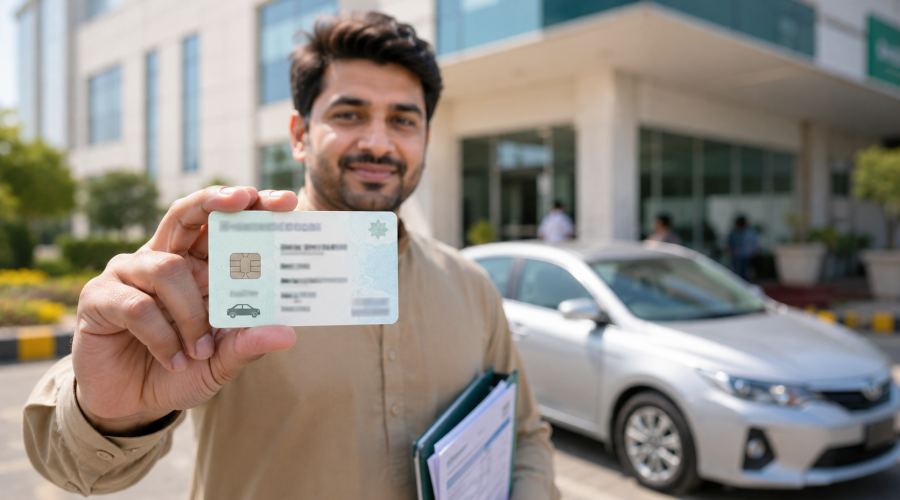
Step 6: Receive your Smart Registration Card
If the biometric verification is successful and all other requirements are met, the vehicle ownership will be officially transferred to the buyer’s name immediately in the system. The new vehicle registration card in the buyer’s name will be printed and sent to the provided address, typically arriving in 10 to 15 days.
If your file is complete, expect 7 to 15 working days for the process. Delays happen when documents are missing, dues are unpaid, or the office has a backlog.
Province-by-Province Process
The underlying process is the same across Pakistan, but the specific offices, apps, and procedures differ by province.
Punjab (Lahore, Faisalabad, Multan, Rawalpindi and all Punjab cities)
Punjab has the most digitised transfer process in Pakistan. Punjab enables online transfer of car ownership via the E-Pay Punjab app, with mandatory biometric verification. Both buyer and seller must complete biometric verification, which can be done at authorised NADRA e-Sahulat centres or provincial Excise offices.
Steps for Punjab:
- Download the E-Pay Punjab app from the Play Store or App Store
- Register with your CNIC, email address, and mobile number
- Log in and go to the Excise Department section
- Select “Transfer of Motor Vehicle” and enter vehicle and buyer details
- Calculate and pay the transfer fee through the app
- Complete biometric verification at an authorised centre
- Submit the application and receive the new registration card
Punjab also offers a 10% discount for payments made before 31 August through the ePay Punjab app.
Read: How to Check E Challan Online in Pakistan
Islamabad (ICT)
Transferring vehicle ownership in Islamabad has become more streamlined in recent years, but it still requires physical verification, document submission, and biometric checks.
The ICT Administration offers services via the City Islamabad App, which allows users to initiate requests online, but the process still requires physical verification at the Excise and Taxation Department office located in Sector H-9, Service Road, near HEC, Islamabad.
Processing time in Islamabad is generally 3 to 4 weeks, though it may vary depending on verification and office workloads.
Sindh (Karachi, Hyderabad, Sukkur and all Sindh cities)
Sindh requires document submission, fee payment, and verification at provincial Excise offices in Karachi, Hyderabad, Sukkur, Larkana, and Mirpurkhas.
A notable development for Sindh in late 2025: Sindh Excise introduced a new Standard Operating Procedure on December 19, 2025, for vehicle ownership transfer without the seller’s biometric, specifically for situations where the seller has disappeared or refuses to cooperate. Buyers submit an application, proof of purchase, a newspaper advertisement, an indemnity bond, and complete NADRA verification within 15 days. This is a practical resolution to a very common problem in the used car market, where sellers sometimes become unreachable after a sale.
Khyber Pakhtunkhwa (Peshawar and KPK cities)
KPK requires document submission, fee payment, and verification at local Excise and Taxation offices. The KPK Excise portal at excise_taxation.kp.gov.pk lists the Motor Vehicle Transfer Fee schedule. The process follows the same general steps as other provinces but does not currently have a centralised app like E-Pay Punjab.
Read: How to Pay Traffic Challan Online in Pakistan
Transfer Fees by Engine Capacity
Fees vary by province and are updated periodically. The most current publicly available figures for Punjab, reported by Pakistan Observer in November 2025, are:
Vehicles with engines not exceeding 1000cc (such as Alto, Mehran, WagonR, and Cultus) incur a transfer fee of Rs 2,750. The transfer fee for vehicles with capacities ranging between 1000cc and 1800cc stands at Rs 5,500. Vehicles exceeding 1800cc attract a fee of Rs 11,000.
Additionally, if a vehicle with an engine up to 1000cc is transferred within ten years of registration, a special charge of Rs 20,000 applies, with a 10% rebate for each completed financial year.
| Engine Capacity | Punjab Transfer Fee (Nov 2025) |
| Up to 1000cc | Rs 2,750 |
| 1001cc to 1800cc | Rs 5,500 |
| Above 1800cc | Rs 11,000 |
| Up to 1000cc (within 10 years of registration) | Rs 20,000 (with annual rebate) |
Sindh and KPK have separate fee schedules. Fees change periodically; confirm current amounts at your local Excise office before visiting.
Vehicle transfer may involve multiple charges beyond the basic transfer fee: any unpaid token tax must be cleared first, there is usually a separate charge for issuing or updating the Smart Card, and late fees may apply if token tax has accumulated over prior years. Always confirm exact totals from your provincial Excise website or office before going.
Read: Pakistan Motorway Speed Limits and Traffic Rules
Transferring Ownership When the Seller Is Unavailable
This is a problem that comes up more often than it should. Buyers sometimes discover after a sale that the previous owner is uncontactable, or in rare cases, that the person who sold them the car wasn’t the registered owner at all.
In Sindh, the new December 2025 SOP specifically addresses this. Buyers can handle the transfer themselves with a newspaper advertisement, an indemnity bond, and NADRA verification within 15 days when the seller is unavailable or refuses biometric verification.
For Punjab and Islamabad, consult the Excise office directly if the seller has disappeared. A formal affidavit, court order, or succession certificate (in the case of a deceased seller) can sometimes facilitate the transfer, but the exact requirements depend on the specific circumstances.
This is precisely why vehicle verification before purchase matters so much. Confirming chassis and engine numbers and checking for fraudulent transactions before completing the sale avoids these complications entirely.
Cross-Province Transfers
If you’re buying a car registered in a different province from where you live, the process involves a few additional steps.
Ownership of a vehicle from another province, for example from Sindh to Punjab, may include additional formalities like a No Objection Certificate from the original province before registration can be completed in the new one.
The seller’s province issues the NOC, and it confirms there are no outstanding dues, fines, or legal holds on the vehicle. Without the NOC, the receiving province won’t process the transfer. This step adds time to the process, so factor it into your timeline if you’re buying across provincial lines.
Common Mistakes That Delay the Transfer
Not clearing token tax before applying. The transfer will be rejected or stalled if there’s unpaid token tax. Check and clear all dues before you step into the Excise office.
Mismatched chassis numbers. If the chassis number on the car doesn’t match the registration book, the Excise inspector will flag it immediately. This is worth checking during the test drive stage, not after you’ve handed over the money.
Incomplete documentation. Missing one document sends you back to square one. The checklist above is comprehensive; go through it methodically before visiting the office.
Relying on a verbal transfer agreement. Sellers and buyers sometimes agree verbally that the seller will “sort out the transfer later.” This leaves the buyer vulnerable if the seller becomes unresponsive. Complete the transfer as quickly as possible after the sale.
Buying through an agent without verifying their credentials. Several third-party services facilitate transfers for a fee. Services like PakWheels Transfers and CarsAds are established and reputable. Random agents outside Excise offices are a different matter and carry risk.
FAQ
Do both buyer and seller have to be present for the transfer?
Biometric verification is mandatory for both the buyer and the seller in most provinces. This process can be completed at authorised NADRA e-Sahulat centres or provincial Excise and Taxation offices. In Sindh, a new 2025 SOP allows buyers to proceed without the seller’s biometric in specific circumstances.
How long does the car ownership transfer take in Pakistan?
The process typically takes 5 to 15 working days, depending on the province and office workload. In Islamabad, it can take 3 to 4 weeks. Incomplete documents or unpaid dues extend the timeline.
Can I transfer car ownership online in Pakistan?
Partially. Punjab’s E-Pay Punjab app handles fee payment and parts of the application process online, but biometric verification still requires a physical visit to an Excise or NADRA e-Sahulat centre.
What happens if I drive a car before the transfer is complete?
The vehicle is still legally registered to the previous owner until the transfer is complete. Traffic fines, liabilities, and any legal issues involving the vehicle remain the seller’s responsibility during this period.
Can I transfer a car registered in Punjab to Karachi (Sindh)?
Yes, but you’ll need a No Objection Certificate from Punjab Excise first. This confirms no outstanding dues exist in Punjab before Sindh can register the vehicle in your name.
Is a sale agreement enough to prove ownership without completing the Excise transfer?
No. A sale agreement is a private document between buyer and seller. Until the Excise and Taxation Department updates the record in their system, the previous owner remains the legally registered owner of the vehicle.
The safest position for any car buyer in Pakistan is to complete the formal ownership transfer before handing over final payment, or to hold back a portion of the payment until the transfer is processed. For sellers, completing the transfer protects you from liability the moment the car leaves your possession. Neither party benefits from delay, and the process itself, once you have all the documents ready, is genuinely manageable.