Pakistan Motorway Speed Limits and Traffic Rules: Complete NHMP Guide
Driving on Pakistan’s motorways feels liberating; smooth roads, long stretches, and beautiful landscapes. But one wrong move, like overspeeding, can turn your journey into an expensive nightmare with heavy fines or worse.
The National Highways & Motorway Police (NHMP) enforces strict rules to ensure safety. In March 2026, the government reduced speed limits nationwide for fuel conservation and road safety. Many drivers are still unaware of these changes, leading to unnecessary challans.
This ultimate guide gives you everything you need: current speed limits on all major motorways, complete traffic rules, fines and penalties, emergency procedures, and practical safety tips. Whether you drive on M-2 (Lahore-Islamabad), M-5 (Multan-Sukkur), or any other route, you’ll be fully prepared.
Rules can be updated — always check official NHMP sources or boards for the latest information.
Current Speed Limits on Pakistan Motorways
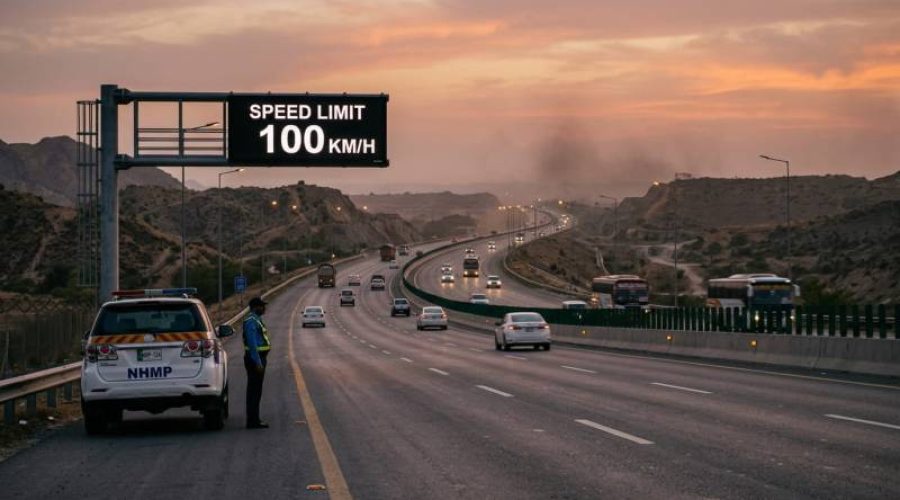
In March 2026, NHMP reduced limits to promote fuel efficiency and reduce accidents:
On Motorways:
- Cars & Light Transport Vehicles (LTVs): Maximum 100 km/h (reduced from 120 km/h)
- Passenger Service Vehicles (PSVs) & Heavy Transport Vehicles (HTVs): Maximum 90 km/h (reduced from 110 km/h)
On National Highways:
- Cars & LTVs: Maximum 80 km/h
- HTVs: Maximum 65 km/h
These limits apply uniformly across M-1 (Peshawar-Islamabad), M-2 (Islamabad-Lahore), M-3, M-4, M-5, M-6, and other operational motorways.
Minimum Speed:
Generally, 60–80 km/h on motorways to maintain smooth flow. Driving too slowly can also result in a challan.
Note: Speed limits may be lower near toll plazas, construction zones, or in bad weather. Always follow road signs.
Read More: How to Pay Traffic Challan Online in Pakistan
Major Motorways in Pakistan & Their Characteristics
M-1 (Peshawar–Islamabad)
155 km, scenic but has hilly sections.
M-2 (Islamabad–Lahore)
375 km, busiest and best maintained.
M-3 (Lahore–Abdul Hakeem)
Connects to southern routes.
M-4 & M-5
Southern motorways have long straight stretches.
M-6 (Sukkur–Hyderabad)
Under expansion.
All follow the same national speed rules in 2026.
Complete Traffic Rules on Pakistan Motorways
1. Lane Discipline
- Keep left unless overtaking.
- Use the right lane only for passing.
- Heavy vehicles must stay in the leftmost lanes.
2. Overtaking Rules
- Overtake only from the right.
- Do not cut in front dangerously.
- Use indicators properly.
3. Emergency & Breakdown Rules
- Switch on hazard lights.
- Move the vehicle to the extreme left or emergency lane if possible.
- Place a warning triangle 100–150 meters behind.
- Call the NHMP helpline 130 immediately.
4. Mobile Phone Use
- Completely banned while driving.
- Use hands-free or Bluetooth only.
5. Seat Belts & Child Safety
- All passengers must wear seat belts.
- Children under 12 must use proper child seats or boosters.
6. Headlights & Indicators
- Use dipped headlights at night.
- Fog lights only in actual fog.
- Always indicate before turning or changing lanes.
7. Prohibited Actions
- No wrong-way driving.
- No overloading.
- No littering.
- No animals or pedestrians on the motorway.
- No sudden stopping except in emergencies.
Read More: How to Renew Driving Licence in Pakistan
Fines and Penalties by NHMP (2026)
Overspeeding remains one of the most common violations:
- Minor overspeeding: Rs. 2,500+
- Serious overspeeding (above 150 km/h): Heavy fine + possible FIR and vehicle impoundment.
- Using mobile phone: Rs. 2,500 – 5,000
- Wrong overtaking: Rs. 1,500+
- Not wearing a seat belt: Rs. 1,000+
- Driving without a valid licence: Rs. 5,000+
Fines can be paid online through e-challan systems or at banks. Repeated violations lead to licence suspension.
Related Guide: Learn how to check and pay your fines quickly → How to Check E Challan Online in Pakistan.
Weather & Special Conditions Rules
- In fog, rain, or poor visibility, reduce speed significantly.
- NHMP may impose temporary lower limits.
- Follow variable message signs (VMS) on motorways.
Emergency Services on Motorways
- Helpline: 130 (24/7)
- Patrol vehicles and rescue teams are stationed at regular intervals.
- Ambulances and tow services available.
- Toll plazas have emergency support.
Advantages of Following Motorway Rules
- Reduced accident risk
- Lower fuel consumption
- Smoother traffic flow
- Avoid heavy fines and legal trouble
- Better driving experience
Pro Tips for Safe Driving on Pakistan Motorways
- Maintain a safe distance (at least 100 meters on high speed).
- Take regular breaks every 2–3 hours.
- Keep an emergency kit (water, first aid, triangle, tools).
- Check tyre pressure and fuel before long journeys.
- Download offline maps and the NHMP app if available.
- Never drive when tired or under the influence.
Frequently Asked Questions
What is the current speed limit for cars on motorways?
100 km/h for cars and LTVs as of 2026.
Can I drive at 110 km/h?
No. You will get a challan.
Is there a minimum speed limit?
Yes, driving too slow can also attract fines.
What if I get a challan on motorway?
Pay online or at designated banks to avoid doubling of fine.
Are speed cameras active?
Yes, NHMP uses extensive camera systems and mobile radars.
Can heavy trucks go at 90 km/h?
Yes, that is the new maximum for HTVs/PSVs.
Final Thoughts and Next Steps
Pakistan’s motorways are among the best in the region, but safety depends on drivers following rules. The reduced speed limits in 2026 are for your own good, they save fuel and, more importantly, save lives.
Action Steps:
- Check your vehicle’s speedometer calibration.
- Plan journeys according to new limits.
- Download offline maps and save NHMP helpline 130.
- Always carry your driving licence and vehicle documents.
Drive responsibly, respect the new speed limits, and enjoy safe journeys across Pakistan.
Share your experiences or questions about motorway driving in the comments. Safe travels!
You May Also Like:
Karachi Peoples Bus Service Routes and Timings
Complete Lahore Ring Road Interchanges List