
How to Find Jobs Online in Pakistan: A Complete Guide
The job market in Pakistan is more competitive than the headline numbers suggest. According to the Pakistan Labor Force Survey 2024-25, youth unemployment among those aged 15 to 24 stands at 12.5%, with urban areas facing rates as high as 17 to 18% for women specifically. Each year, roughly 2 million young Pakistanis enter the workforce. The competition is real.
The good news is that knowing where to look for jobs online in Pakistan, and how to use those platforms properly, makes a measurable difference. Most job seekers use a handful of platforms passively, skip LinkedIn entirely, and ignore the referral networks that actually fill most positions. This guide covers all of it.
The Main Job Portals in Pakistan
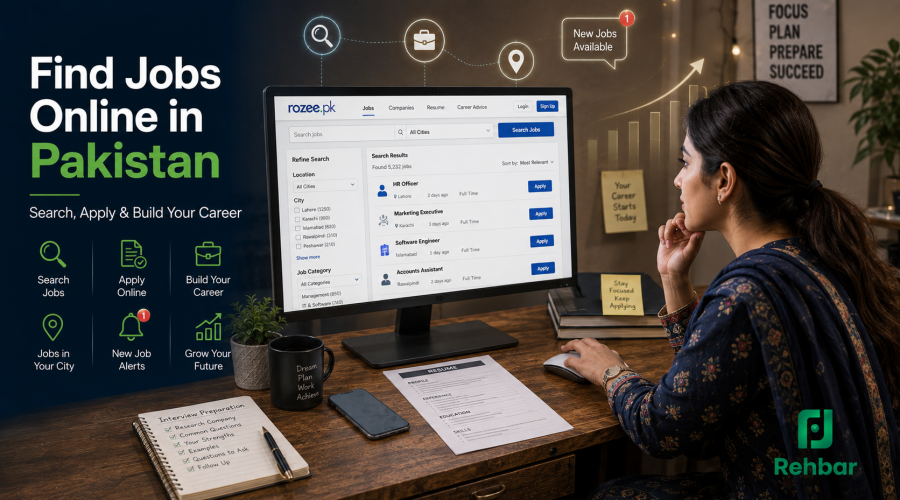
Rozee.pk
Rozee.pk is Pakistan’s largest job portal and the natural starting point for most job seekers. Rozee.pk is Pakistan’s largest digital careers platform with 10 million registered salaried professionals, and is the first VC-funded startup and industry leader in recruiting and human capital management in Pakistan.
The platform has more than 100,000 job listings and a network of more than 52,000 companies posting jobs. It receives over 6 million unique visitors per year and adds more than 110 new job postings each day.
Rozee works best when you use its advanced filters. You can search by city, industry, functional area, experience level, career level, and even gender preferences for advertised roles. Setting up a complete profile with a detailed skills section and a proper job title significantly increases your chances of appearing in recruiter searches, because Rozee’s recruiter side lets employers search the candidate database directly.
Set up job alerts for your target roles. These land in your email daily and are far more reliable than manually checking the site, which most people don’t do consistently.
Read More: How to prepare for a job interview in Pakistan
Mustakbil.com
Mustakbil is a prominent Pakistani job site that stands out for its detailed job listings and advanced search filters, which help job seekers find the most suitable roles efficiently. It also offers career development resources, making it useful beyond just applications.
Mustakbil tends to index roles from government-linked organizations, banks, and development sector employers more systematically than Rozee. If you’re targeting those sectors specifically, Mustakbil is worth checking separately rather than assuming overlap with Rozee.
BrightSpyre
BrightSpyre has more than 1.6 million active users with an average of 10,000 new users signing up each month, making it one of the fastest growing job portals in Pakistan. It’s particularly strong for development sector jobs, NGO roles, UN agency positions, and academic posts. If you’re a fresh graduate or targeting civil society organizations, BrightSpyre is specifically worth having on your regular search list.
Indeed Pakistan
Indeed aggregates job listings from multiple sources, including company websites that might not post directly to Rozee or Mustakbil. Indeed allows you to target specific locations, employment types, and job categories, and includes CV assessment tools and compensation benchmark data for different companies.
The value of Indeed in Pakistan is particularly in catching listings that originated on company career pages. Many larger organizations post directly to their own websites and to Indeed, but not to the local portals.
PaperPk.com
PaperPk is among the oldest job portals in Pakistan because it’s the only portal that aggregates job advertisements from leading newspapers including Jang, Dawn, Express, The News, and Nawaiwat. It covers government and private sector vacancies in education, healthcare, the armed forces, banks, and public administration.
If you’re targeting government jobs or roles that are still primarily advertised in newspapers, PaperPk saves you from buying a physical paper every morning.
Read More: How to Make CV Online in Pakistan
How to Find Government Jobs Online in Pakistan
Government jobs attract some of the most intense competition in Pakistan. The application processes are specific, so knowing the right portals matters.
Federal Public Service Commission (FPSC): The FPSC handles federal government appointments across all of Pakistan. Applications are submitted online through www.fpsc.gov.pk. The commission announces advertisements for positions across Islamabad and nationwide, covering sectors from education and healthcare to engineering and administration.
Punjab Public Service Commission (PPSC): The PPSC recruits for Punjab-domiciled positions across Punjab’s government departments. Applications go through ppsc.gop.pk. Roles span police, health, education, agriculture, and engineering departments.
National Testing Service (NTS): Many government departments use NTS as a third-party testing service for initial screening. NTS has its own portal at nts.org.pk where test schedules, results, and job announcements appear.
Sindh, KP, and Balochistan commissions: Each province has its own public service commission: SPSC (spsc.gov.pk) for Sindh, KPPSC (kppsc.gov.pk) for Khyber Pakhtunkhwa, and BPSC (bpsc.gov.pk) for Balochistan. Apply through the relevant provincial portal for domicile-restricted positions.
A practical tip for government job seekers: bookmark the official portal for your target commission and check it weekly. Third-party job sites that compile government job listings sometimes have delays or errors in their listings. The authoritative source is always the official commission website.

LinkedIn: The Platform Most Pakistani Job Seekers Underuse
LinkedIn is where a significant portion of Pakistan’s formal private sector and corporate recruitment actually happens, and most Pakistani job seekers either don’t have a profile or have one that’s largely empty.
Profiles with professional photos receive 14 times more views than those without. Profiles with smiling photos are rated twice as likable as those with closed-mouth expressions. That’s a low-effort fix that most people skip.
Your headline matters more than your job title. Crafting a compelling headline of up to 220 characters with industry-specific keywords makes you more visible to recruiters searching on LinkedIn. Your current role, expertise, and a brief value proposition will set you apart.
A practical LinkedIn profile checklist for Pakistani job seekers:
Profile photo: Clear, professional, plain background. Your face should fill most of the frame.
Headline: Not just your job title. Add your specialization and what you offer. Example: “Software Engineer | Python and Django | Fintech Applications” is better than just “Software Engineer.”
About section: Write in first person. Tell recruiters what you do, what you’re good at, and what you’re looking for. Include terms that Pakistani recruiters in your sector would search for.
Experience section: Each role should have 3 to 5 bullet points describing what you actually did and what the measurable outcomes were. “Managed social media accounts” is weak. “Grew Instagram followers from 8,000 to 47,000 in 12 months through organic content strategy” is specific and memorable.
Skills: Add relevant skills and get endorsements from colleagues. LinkedIn’s algorithm surfaces profiles with more complete skills sections.
Open to Work: Turn this on. It signals to recruiters that you’re actively looking and puts a green frame on your photo visible to hiring managers.
Using LinkedIn’s Job Search
LinkedIn’s job search at linkedin.com/jobs lets you filter by location (Pakistan, or specific cities like Karachi, Lahore, Islamabad), job type, experience level, and date posted. Filtering by “Past 24 hours” or “Past week” shows the freshest listings and reduces competition from applications that have been accumulating for weeks.
“Easy Apply” positions let you apply with your LinkedIn profile directly, which is fast. Roles requiring an external application are often worth more effort because they filter out the casual applicants who only use Easy Apply.
The Role of Networking in Pakistan’s Job Market
This is where most job seekers leave significant opportunity on the table.
A 2025 LinkedIn workforce report found that 85% of jobs are filled through networking, meaning the vast majority of successful hires come from some form of personal or professional connection rather than cold applications.
Referred candidates are 4 to 5 times more likely to be hired than non-referred applicants, and they get hired roughly 30% faster, typically within 30 days versus 40 to 45 days for job board hires.
In Pakistan’s job market specifically, personal networks and referrals carry enormous weight in private sector hiring. Many roles at smaller companies and agencies are never formally posted. They’re filled through WhatsApp forwards, phone calls to trusted contacts, or a manager asking a colleague if they know anyone suitable.
How to build your professional network actively:
LinkedIn is the most systematic way. Connect with professionals in your field, not just your immediate contacts. Send a short, personalized connection request explaining why you’re connecting. Once connected, engage genuinely: comment on their posts, share relevant content, ask a specific question about their work.
Inform your existing network you’re looking. Tell former classmates, professors, family connections in relevant industries, and previous colleagues that you’re looking for work in a specific field. Be specific about what you’re looking for — “I’m looking for marketing roles at digital agencies in Lahore” is much more actionable than “I’m job hunting.”
Alumni networks matter. Pakistani universities like LUMS, IBA, NUST, and others have active alumni networks on LinkedIn and sometimes on WhatsApp. A message to an alumnus who works at a company you’re targeting is far warmer than a cold application and gets noticed.
Attend industry events. Tech meetups, marketing conferences, entrepreneurship events in Karachi, Lahore, and Islamabad create face-to-face connections that carry more weight than digital ones. Events like Startup Grind Pakistan, the PASHA ICT Summit, and TiE Pakistan create industry-specific networking environments.

Platform Comparison: Where to Focus Your Time
| Platform | Best For | Key Strength |
| Rozee.pk | Private sector, all levels | Pakistan’s largest active job database |
| Corporate, tech, mid-senior roles | Recruiter visibility, networking | |
| BrightSpyre | NGOs, development sector, academia | Sector-specific listings |
| Indeed Pakistan | Catching company career page listings | Aggregation from multiple sources |
| Mustakbil | Banking, development, government-linked | Detailed filters, career resources |
| PaperPk | Government, newspaper-advertised roles | Newspaper job aggregation |
| FPSC/PPSC portals | Federal and provincial government | Official government positions |
How to Apply More Effectively
Having the right platforms isn’t enough if your applications are generic. Here’s what actually moves applications forward:
Customize your CV for each role. At minimum, adjust your CV summary to mirror the language in the job description. If the listing mentions “digital marketing with a focus on performance campaigns,” your CV should use that phrase in describing your experience.
Write a proper cover letter when one is asked for. Most Pakistani applicants skip this or send generic templates. A cover letter that mentions the company by name, references something specific about the role or company, and makes a clear case for why you’re applying stands out immediately.
Follow up. Applying and waiting is the passive approach. If you can find the hiring manager on LinkedIn, send a brief, professional note after applying saying you’ve submitted your application and you’re genuinely interested in the role. Don’t be pushy; one message is enough.
Apply early. When you apply cold to a posted job, you’re competing against hundreds of other applicants, and your resume has less than a 1% chance of leading to an interview. Applying within the first 24 to 48 hours of a posting going live gives you a real advantage before the hiring manager’s inbox fills up.
Read More: How to Use ChatGPT for Online Earning
Avoiding Online Job Scams
Pakistan’s online job boards, and especially WhatsApp job forwards, carry a real risk of fraudulent listings. A few practical protections:
If any recruiter or employer asks you to pay money for any purpose including processing fees, registration, or training, do not pay. Legitimate employers never charge job seekers. Rozee.pk itself maintains a public list of companies flagged for fraudulent recruiting complaints.
Cross-verify any opportunity. Search the company name alongside “scam” or check their Google Business profile and LinkedIn company page. Established companies have a traceable online presence.
Be cautious with roles advertised only on WhatsApp without a formal application link or company name. Serious employers use formal channels.
Frequently Asked Questions
Which is the best website to find jobs in Pakistan?
Rozee.pk is the largest and most widely used Pakistani job portal with over 100,000 active listings. LinkedIn is the most effective for corporate and mid-to-senior roles. For government positions, use the official FPSC and PPSC portals directly. Most serious job seekers use three or four platforms simultaneously.
How do I find remote jobs from Pakistan?
LinkedIn’s job search lets you filter by “Remote” under job type. Platforms like Remote.co, We Work Remotely, and LinkedIn’s remote filter are the most reliable for international remote positions available to Pakistanis. For freelance work rather than salaried remote employment, Upwork and Fiverr are more relevant.
Read More: How to become Freelancer in Pakistan
Do Pakistani employers check LinkedIn?
Yes, especially in corporate, tech, marketing, and finance sectors. Many recruiters in Pakistan’s formal private sector source candidates directly from LinkedIn before even posting a job publicly. A complete, active profile is worth the time investment even if you’re not actively job hunting.
Is it better to apply through a job portal or directly on a company website?
Applying on a company’s own website is often better because your application goes directly into their applicant tracking system without a third-party layer. Check the company’s career page directly before assuming they only post to Rozee or Indeed.
How do I know if a job listing is real or fake?
Real employers never ask for payment. Cross-check the company name on LinkedIn and Google. Look for a verifiable company website. If the listing has a generic email address (Gmail, Yahoo) rather than a company domain, treat it with caution.
The most effective job search in Pakistan combines active use of the right portals, a properly optimized LinkedIn profile, and consistent effort to build and activate your personal network. Job portals get you in front of advertised roles. Networking gets you in front of roles that never get advertised.
Start with Rozee.pk and LinkedIn this week. Set up job alerts for your target roles on both. Then spend 30 minutes connecting with five people in your field on LinkedIn and letting them know you’re looking. That combination already puts you ahead of most people applying for the same positions.