How to Prepare for a Job Interview: A Complete Guide
Getting a job interview is already the hard part. On average, corporate job openings receive 250 resumes per position, and only 4 to 6 candidates get shortlisted for interviews. You’ve cleared that filter. Most people haven’t.
What happens next determines whether all of that effort converts into an offer or another rejection email. Preparation is what separates candidates who get hired from candidates who interview well on paper but stumble in the room.
This guide covers every stage of interview preparation in the order you should do it, drawing on hiring data and behavioral research. No generic “be yourself” advice. Just what works.
Understand What You’re Actually Up Against
Before preparing anything, it helps to understand how interviewers actually make decisions, because the process is more irrational than most people realize.
Research shows interviewers typically form their opinion about a candidate within the first 7 minutes of the interview. Fifty-two percent of interviewers assess candidates within 5 to 15 minutes of the interview starting.
That’s not a lot of time for your actual qualifications to come through. It means your opening impression, your energy, your preparation signals, and your ability to communicate clearly all carry disproportionate weight.
Around 70% of candidates fail interviews due to poor preparation, and 62% of employers reject candidates specifically based on poor communication skills. The good news is that both of those things are fixable before you walk in.
Read More: How to Find Jobs Online in Pakistan
Step 1: Research the Company Properly
Approximately 47% of candidates fail job interviews because they lack sufficient information about the company. This is one of the most avoidable reasons for rejection, and it signals to an interviewer that you’re not genuinely interested in the role.
Proper company research is not just skimming the About Us page. Here’s what you actually need to know:
The company’s product or service: Be able to explain what they do in one or two sentences as if you’re telling a friend. If you can’t do this, you haven’t researched enough.
Recent news: A 2024 survey found that 70% of hiring managers expect candidates to know recent developments, like a new product launch or a merger. Dropping these details into your answers shows you’ve done your homework and care about the role.
The company’s stated values: Most companies publish these on their website. Read them critically and think of one or two concrete examples from your own experience that connect to those values. Don’t memorize them to recite; internalize them to reference naturally.
Your interviewer’s background: If you know who’s interviewing you, look them up on LinkedIn. Their career history, posts, and interests give you context that helps you build rapport and frame your answers to what they likely care about.
Glassdoor reviews: Current and former employee reviews reveal what the culture is actually like versus what the company’s website claims. Read critically, look for consistent themes, and use this to prepare smart questions.
Employee reviews on Glassdoor and similar sites tell you what it’s actually like to work there. Some might complain about career growth, so weigh that against positive notes; both current and past workers give useful signals.
Read More: How to Make CV Online in Pakistan
Step 2: Prepare Your STAR Stories
Around 80% of employers use behavioral interview questions in their hiring process. These are the questions that start with “Tell me about a time when…” and they’re designed to get evidence of how you’ve behaved in real situations, on the assumption that past behavior predicts future performance.
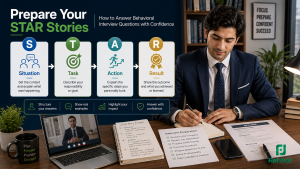
The STAR method is the standard framework for answering these. The STAR method, which stands for Situation, Task, Action, and Result, provides a proven structure for answering behavioral questions clearly and concisely. Behavioral interviews are used by approximately 73% of employers, making STAR preparation important for today’s job seekers.
Here’s how the four parts break down:
Situation (about 20% of your answer): Set the context briefly. What was happening? What was the environment? Don’t over-explain.
Task (about 10%): What was your specific responsibility or challenge in that situation?
Action (about 60%): This is the heart of the answer. What did you personally do? Interviewers want to hear “I” not “we.” Be specific about your decisions, your approach, and your reasoning.
Result (about 10%): What was the outcome? Quantify it wherever you can. “The team’s delivery time improved by 30%” is far stronger than “things got better.”
Read More: Best AI Tools for Business Owners
Building Your Story Bank
Prepare 6 to 8 STAR stories before any interview. They should cover a range of themes: a conflict you resolved, a time you failed and what you learned, a project you led, a situation where you had to adapt quickly, a time you went beyond your job description.
Around 61% of employers say that providing specific examples of past achievements improves interview success. Generic answers like “I’m a great team player” land flat. A specific story about the time you stepped in during a team crisis, what you decided, and what the measurable outcome was lands entirely differently.
Common behavioral questions to prepare for:
Tell me about a time you failed. Almost every serious interview includes this. The interviewer isn’t looking for a confession; they’re checking your self-awareness and ability to learn. Pick a real failure, explain what went wrong, and focus more on what you changed afterward than on the failure itself.
Describe a time you had a conflict with a colleague or manager. Pick a real example where the conflict resolved constructively. Avoid anything that makes you sound like you hold grudges or blame others.
Give an example of a time you handled a difficult customer or stakeholder. Focus on listening, calm communication, and the resolution.
Step 3: Prepare Smart Questions to Ask
Around 58% of interviewees prepare questions to ask their interviewers, which improves their overall impression. Saying “no, I think we’ve covered everything” when asked if you have questions is one of the quieter ways to sabotage an interview.
Good questions signal genuine interest and intelligence. Here are the types that work:
Questions about the role’s challenges: “What would success look like in this role after 90 days?” shows you’re already thinking about contribution, not just getting hired.
Questions about the team: “How does this team typically collaborate with other departments?” tells you about the working culture and shows you’re thinking about integration.
Questions about why the role is open: “Is this a newly created position or are you replacing someone?” is legitimate to ask and gives you useful information about growth versus replacement.
Avoid asking about salary, holidays, or remote work policies in a first interview unless the interviewer brings it up. Those conversations belong later in the process.
Step 4: Prepare What You’ll Wear
Around 75% of hiring managers say that professional appearance influences their hiring decision, and 50% of interviewees say that dressing professionally influences the interview outcome.
The baseline rule: dress one level above what you expect the company’s daily dress code to be. If the office is business casual, wear smart business attire. If the office is casual, wear smart casual. If you’re genuinely unsure, it’s better to be slightly overdressed than underdressed.
Around 71% of companies will reject an applicant if they aren’t dressed appropriately. That’s a significant filter to trip on when everything else is going well.
For video interviews specifically, the same standards apply from the waist up. Check your lighting (natural light facing you or a lamp directed at your face, not behind you), your background (clean and uncluttered), and your audio quality. A cheap USB microphone makes a real difference if you’re doing many remote interviews.
Step 5: Work on Your Body Language
Research shows that body language accounts for approximately 55% of communication, and a study at Harvard Business School found that job seekers who displayed confident body language including maintaining eye contact, sitting up straight, and offering a firm handshake were more likely to be perceived as competent and hireable.
Around 73% of interviewers say that a candidate’s body language influences their final decision.
You don’t need to overthink this, but a few specific things matter:
Eye contact: Maintain it consistently without staring. In a panel interview, give your initial response to whoever asked the question, then distribute eye contact to the others in the room as you continue answering.
Posture: Sit forward slightly, not slouched back. Slouching signals disinterest. Leaning forward slightly signals engagement.
Hands: Keep them visible on the table or in your lap. Crossing arms signals defensiveness. Fidgeting signals anxiety.
Smile genuinely: Research into employer perceptions found that the two main facial behaviors sought by employers in interviews were smiling and eye contact. A stiff, unsmiling candidate reads as cold or nervous, both of which work against you.
Practice your answers in front of a mirror or record yourself on your phone. Most people are surprised by what they see. Nervous habits like looking down, touching your face, or rushing through sentences are invisible to you until you watch yourself back.
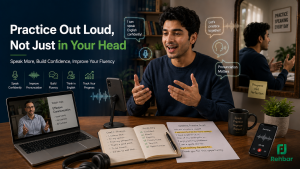
Step 6: Practice Out Loud, Not Just in Your Head
This is where most people cut corners. Reading your STAR stories in your head and saying them out loud are completely different experiences. Your brain knows what you mean to say; your mouth has to do the actual work.
Around 85% of recruiters agree that passion and enthusiasm are visible in interviews and heavily impact hiring decisions. Enthusiasm is partly about what you say and substantially about how you say it. That quality only develops through spoken practice, not mental rehearsal.
Practice options that actually work:
Record yourself on your phone: Answer a question, stop the recording, play it back. Notice where you rush, where you lose the thread, where you sound flat or unconvincing.
Practice with someone you trust: Ask a friend or family member to ask you questions from a list. The social pressure of a real audience changes how you respond in a way that solo practice doesn’t.
Use AI interview tools: Platforms like Google’s Interview Warmup (free) and Big Interview let you practice answering questions on camera and give you feedback on filler words, pacing, and structure. These are particularly useful for people who don’t have a practice partner available.
Step 7: Handle the Salary Question
Most candidates either dodge the salary question or undersell themselves by naming a figure too early. Neither approach is ideal.
Studies show that only 37% of professionals negotiate their starting salary, even though a single successful negotiation can add thousands to annual income that compounds over an entire career.
If a recruiter asks your salary expectation before an offer:
“I’m looking for something in the range of X to Y based on my research into this role and the market. That said, I’m more interested in the total package and the opportunity than a specific number. What’s the budgeted range for this position?”
That approach gives a range (which anchors the conversation without committing you), invites transparency from their side, and signals that you’re not purely transactional.
Research your market rate before any interview using Glassdoor, LinkedIn Salary, or Levels.fyi for tech roles. Going in without a number in mind leaves you at a disadvantage.
According to the 2026 Salary Guide from Robert Half, 88% of professionals say they feel confident negotiating salary after a job offer, suggesting that salary negotiation is becoming a normal, expected part of the hiring process rather than an uncomfortable exception.
The Day Before and the Day Of Interview
The day before, confirm the interview location (or link for virtual), the interviewer’s name, and how long the journey takes with buffer time factored in. Lay out your clothes. Print any documents you’re bringing. Get to bed at a reasonable time.
On the day itself, arrive 10 to 15 minutes early for in-person interviews. Arriving on time literally means arriving at the start time, which often means a rushed entry. Arriving 5 minutes early is the practical ideal. Use any waiting time to breathe calmly, not to frantically review your notes.
Research shows that foreign language and speaking anxiety occurs most when people are unprepared. The equivalent applies to interview anxiety: preparation is the primary intervention. If you’ve rehearsed your stories, researched the company, and thought through your questions, the conversation feels structured rather than unpredictable.
After the interview, send a short thank-you email within 24 hours. It doesn’t need to be long: two or three sentences referencing something specific from the conversation and reaffirming your interest. Successful candidates demonstrate strong initiative, with 84% scheduling their interviews within 24 hours of receiving an invitation. The same proactive energy in your follow-up signals you’re serious about the role.
Frequently Asked Questions
How long should I spend preparing for a job interview?
The average time candidates spend preparing is about 6 hours. For a senior role or a company you particularly want to work for, 8 to 10 hours is reasonable. Spread that preparation over a few days rather than cramming it the night before.
What should I bring to a job interview?
Bring printed copies of your CV (at least two, in case there are multiple interviewers), a notepad and pen, any portfolio work or documentation the employer requested, and the name and contact number of someone at the company in case you need to reach them on the day.
Is it okay to pause and think before answering a question?
Yes. A brief pause of two to three seconds to gather your thoughts reads as composure, not confusion. Filling silence with filler words like “um” or “uh” while your brain catches up is the thing to avoid. Practice pausing calmly rather than rushing into an unfocused answer.
What do I do if I don’t know the answer to a question?
Be honest rather than blustering. “I don’t have direct experience with that, but here’s how I’d approach learning it…” is a legitimate and respected answer. Interviewers know your full professional history; they’re also assessing your honesty and self-awareness.
Should I send a thank-you email after an interview?
Yes, always. Keep it short and specific to the conversation you had. It’s a small gesture that a meaningful percentage of candidates skip, which means doing it already differentiates you.
Read More: How to make a CV online in Pakistan
Most interviews are won or lost before the candidate walks into the room. The research, the story preparation, the practice out loud, the thought put into body language and presentation: all of that does more work than whatever brilliant improvised answer you hope to come up with on the spot.
Start your preparation at least a week before the interview date. Give yourself enough time to practice properly rather than reviewing notes the morning of and hoping for the best.
Read More: How to improve your English speaking skills