
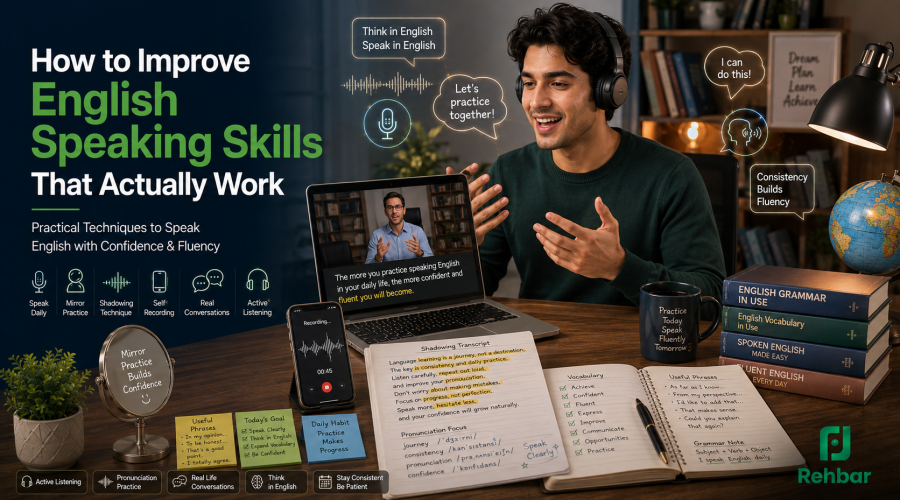
How to Improve English Speaking Skills That Actually Work
Most people trying to improve their English speaking skills already know the generic advice. Watch movies. Read books. Listen to podcasts. They’ve heard it a hundred times and still feel stuck the moment they open their mouth in front of another person.
The problem isn’t information. It’s that most advice skips the real barriers: speaking anxiety, the gap between understanding English and producing it, and the fact that passive exposure alone almost never builds fluency. This guide cuts through that. Every method here is grounded in published research or documented practice from language teachers and speech experts.
Why Speaking Feels So Much Harder Than Reading or Listening
Understanding a language and speaking it are genuinely different cognitive tasks. Reading English and listening to English are receptive skills. Speaking is a productive skill, and it demands real-time processing under social pressure.
Research published in 2025 found that psychological barriers like shyness and fear of judgment consistently appeared as major obstacles to English speaking performance, alongside structural issues like limited practice time. This matters because it means improving your speaking isn’t just about learning more English. It’s also about building the confidence to actually use what you already know.
Studies on English language anxiety show that learners feel most stressed about speaking when they fear being laughed at or ridiculed for making mistakes in pronunciation, grammar, or vocabulary. That fear is deeply rational in social terms, but it’s also the single biggest thing holding most intermediate learners back.
The methods below are organized with this psychology in mind: some are designed for solo practice precisely because they remove the social pressure entirely.
Read More: Top 30 Private Schools in Karachi [Complete List]
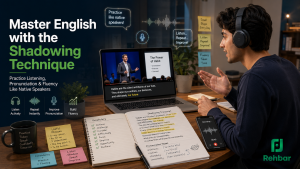
The Shadowing Technique: The Most Underused Speaking Method
If you’ve never heard of shadowing, this section alone is worth bookmarking.
Shadowing is a practice where you listen to a native speaker and simultaneously repeat what they’re saying, mimicking their pronunciation, rhythm, and intonation as closely as possible. Research shows that regular shadowing practice can greatly improve pronunciation accuracy, listening comprehension, and natural speech patterns, and increases confidence in real-life communication.
Shadowing is especially useful for learners who don’t have regular access to native speakers or conversational environments. That makes it particularly relevant for learners in Pakistan, South Asia, and other regions where English-medium conversation opportunities are limited outside formal education.
A 2025 study found that 24 out of 30 participants reported feeling more motivated to practice after engaging in shadowing exercises, with 21 stating that replicating native speech gave them a sense of achievement that reduced their anxiety.
Read More: Best Universities for Girls in Lahore [Updated]
How to Practice Shadowing
- Choose audio of a native or highly proficient English speaker at a natural pace. TED Talks, BBC news clips, and YouTube channels like Kurzgesagt work well because the speech is clear and well-paced.
- Start with a short segment of 20 to 30 seconds.
- Listen once all the way through without repeating.
- Play it again and speak along simultaneously, matching the rhythm, pauses, and stress patterns as closely as you can.
- Record yourself doing this and compare it to the original. The gap between what you hear and what you produce tells you exactly what to work on.
Research on Taiwanese university students found that shadowing-based practice produced measurable gains in fluency through increased speech rate and fewer hesitation markers. You don’t need expensive software or a tutor to do this. You need a phone, headphones, and 15 minutes a day.
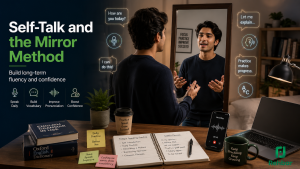
Practice Speaking Alone: Self-Talk and the Mirror Method
You don’t need a conversation partner to improve your spoken English. Practicing alone is legitimate, effective, and much less intimidating, especially at the beginning.
Self-talk means narrating your own day in English. Getting out of bed? Say it: “I woke up at seven. It’s cold today. I’m going to make chai and check my messages.” Speaking without interruptions forces you to form sentences quickly, improves response time, and removes the pressure of making mistakes in front of others.
The goal isn’t perfect sentences. It’s building the habit of thinking in English rather than translating from your first language.
Read More: Best Universities for Girls in Islamabad [Updated]
Mirror practice takes self-talk further. A qualitative research study found that mirror practice enhances self-confidence, reduces anxiety, and supports self-correction in pronunciation and body language, with participants using structured activities like self-introductions, storytelling, and impromptu speeches while observing their reflections.
Spending 10 to 15 minutes daily on mirror practice builds long-term fluency and confidence, and recording your voice alongside it lets you track progress in pronunciation, vocabulary, and grammar over time.
A simple weekly structure for solo practice:
| Day | Activity | Time |
| Monday | Describe your weekend out loud | 10 min |
| Tuesday | Shadowing with a TED Talk clip | 15 min |
| Wednesday | Mirror: introduce yourself in different contexts | 10 min |
| Thursday | Read a news article out loud, then summarize it | 15 min |
| Friday | Record yourself speaking on any topic and listen back | 10 min |
| Weekend | Use any of the above casually, no pressure |
The recording step is one most learners skip and shouldn’t. A monthly one-minute video of yourself discussing the same topic provides concrete evidence of your progress in pronunciation, fluency, and overall speaking confidence.
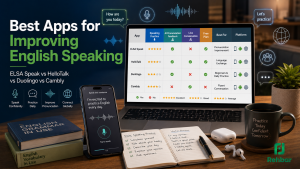
The Best Apps for Improving English Speaking
Apps can’t replace real practice, but the right ones add genuine value at zero or low cost.
Read More: Best Universities for Boys in Lahore [Updated]
ELSA Speak
ELSA stands for English Language Speech Assistant. ELSA Speak is an AI pronunciation coach that allows you to engage in real-time speaking scenarios including job interviews, presentations, and meetings, with free and paid versions available on iOS and Android.
It gives you phoneme-level feedback, meaning it tells you exactly which sounds you’re mispronouncing rather than just saying you sound “unclear.” For learners whose first language is Urdu, Hindi, or Punjabi, where certain English phonemes don’t exist natively, this kind of specific feedback is more useful than general listening practice.
HelloTalk
HelloTalk combines native speaker corrections, AI tools, and live speaking practice in one environment, and is often described as the most comprehensive option for real improvement that transfers to real-life speaking.
You’re matched with native or advanced English speakers who want to learn your language. You help them with Urdu or your local language; they correct your English. It’s a genuine exchange, and corrections from real people carry weight that algorithm feedback sometimes doesn’t.
Cambly
Cambly connects you with native English tutors for live video conversations, on demand. Lessons start from around $10 per hour depending on the tutor’s background. Users consistently report that Cambly gave them the confidence to actually speak out loud rather than just passively read or listen, with the flexibility to pick your tutor, time, and topic.
It’s not free, but a single 30-minute session once a week is significantly cheaper than formal English classes and far more speaking-focused.
Duolingo (With Realistic Expectations)
Duolingo is excellent for habit-building and vocabulary, less so for speaking fluency. Its gamified structure makes daily practice feel less like homework. Duolingo works well for beginners building a habit, with a practical path being to start on Duolingo and transition to HelloTalk as your base vocabulary grows.
Don’t expect Duolingo alone to make you fluent. Use it as the habit layer while doing more speaking-intensive practice on the side.
App Comparison at a Glance
| App | Best For | Free Tier | Cost (approx.) |
| ELSA Speak | Pronunciation feedback | Yes (limited) | ~$12/month |
| HelloTalk | Conversation exchange | Yes | ~$7/month premium |
| Cambly | Live tutoring | No | ~$10+ per session |
| Duolingo | Habit building, vocabulary | Yes | ~$7/month Plus |
How to Watch English Content the Right Way
Watching TV shows and films in English is genuinely useful, but only if you watch actively. Passive background viewing doesn’t build speaking skills. Your brain needs to engage.
The subtitle switch: Start with English audio and English subtitles. Once you can follow without reading every word, switch to English audio and no subtitles. The discipline of forcing yourself to listen, rather than read, builds your ear for natural speech patterns, connected speech, and the rhythm of English sentences.
The repeat-and-speak method: Find a short scene with dialogue you find interesting. Watch it once. Then watch it again and pause after each line to repeat what was just said. Try to match the actor’s tone, pace, and stress. This is essentially shadowing applied to film, and it’s one of the most enjoyable ways to practice.
Shows with clear, well-paced dialogue work better than fast-edited action films. The US version of The Office, Friends, and documentary-style content on YouTube tend to have natural conversation patterns without too much slang or extreme regional accents.
Read More: Best Universities for Boys in Karachi [Updated]
Dealing With Speaking Anxiety Directly
This deserves its own section because speaking anxiety is not just nervousness. It’s a real psychological barrier that worsens with avoidance.
Research shows that foreign language speaking anxiety occurs most strongly when speakers are unprepared. The key intervention is preparation: drafting what you want to say, asking for feedback in advance, and familiarizing yourself with the topic structure to the point where you don’t need to read from notes.
A gradual exposure approach works well: start by speaking up in very small group settings, then move to slightly larger groups as your confidence grows. This allows confidence to build incrementally without the overwhelming pressure of jumping straight into large audiences.
Three things that specifically help with English speaking anxiety:
Talk to yourself first. Before any high-stakes English conversation (a job interview, a meeting, a phone call), spend five minutes talking to yourself about what you’ll say. Preparation physically reduces the anxiety response.
Accept imperfect grammar. Native speakers make grammatical “errors” constantly in natural speech. No one speaks in the perfectly structured sentences found in textbooks. The goal of spoken English is communication, not a grammar exam.
Use filler phrases confidently. “That’s a great question,” “Let me think about that for a moment,” and “What I mean is…” are not signs of weakness. Native speakers use them constantly. Knowing a handful of these phrases gives you a few seconds to gather your thoughts without the conversation collapsing.
Build English Into Your Daily Routine
Fluency doesn’t come from weekend study sessions. It comes from daily micro-exposure that compounds over months.
Here’s what daily integration can realistically look like even for someone with a full schedule:
Morning (5 minutes): Listen to one BBC World Service news bulletin or a short English podcast during chai. You’re not actively studying. You’re training your ear.
Commute or downtime (10 minutes): Narrate what you see, think about, or plan in English. No one needs to hear you.
Evening (15 minutes): Do a focused activity: shadowing, a HelloTalk exchange, an ELSA session, or a mirror practice run.
That’s 30 minutes a day. Consistent for 60 days, most learners at the intermediate level report noticeable improvement in fluency and confidence according to language coaches and self-reported data from apps like Duolingo and HelloTalk.
Read More: Best Universities for Boys in Islamabad [Updated]
A Note on Pronunciation
Pronunciation improvement is a specific sub-skill with its own mechanics. You can understand English well and still be difficult to understand when you speak, purely because of accent interference from your first language.
The most effective pronunciation practice isolates individual sounds you struggle with and drills them in context. For Urdu and Punjabi speakers, common challenges include the English “p” vs “b” distinction, the “v” vs “w” sounds, and the schwa vowel sound that appears in words like “the,” “a,” and unstressed syllables throughout English speech.
ELSA Speak addresses this at the phoneme level. Shadowing addresses it at the rhythm and intonation level. Used together, they cover most pronunciation gaps.
Frequently Asked Questions
How long does it take to become fluent in English speaking?
Honest answer: it depends heavily on your current level, how much time you put in daily, and how much direct speaking practice you get. Language research generally puts intermediate-to-advanced fluency at 600 to 800 hours of quality practice for adult learners starting from a basic foundation. At 30 minutes a day, that’s 3 to 4 years. At 2 hours a day with active speaking practice, it shortens significantly. Progress is nonlinear and tends to come in sudden jumps after long plateau periods.
Can I improve my English speaking without spending money?
Yes. Shadowing with free YouTube or TED Talk content, self-talk, mirror practice, HelloTalk’s free tier, and the University of Cambridge’s free Speak and Improve platform are all zero-cost and genuinely effective. Speak and Improve, a free browser-based research project from the University of Cambridge, attracted 1.7 million users and over 18 million submitted answers between its launch in 2018 and 2024, covering learners from beginner to advanced levels.
Is it bad to have an accent when speaking English?
No. Having an accent is not the same as being difficult to understand. The goal of accent improvement is intelligibility, not sounding like a BBC presenter. Many highly effective English communicators in business, academia, and public life speak with strong regional or national accents.
What’s the best content to shadow for Pakistani learners specifically?
TED Talks by non-native English speakers are often more useful than native speaker content for people starting out, because the speech tends to be slower and more deliberate. Try TED talks by people from India, Turkey, or Nigeria — their English is clear and highly intelligible, and the pace makes shadowing more manageable. Move to BBC or American content as your confidence grows.
I understand English well but freeze when speaking. What’s happening?
This is one of the most common problems for intermediate learners and it’s well-documented in language research. You’re experiencing a production block: your receptive skills (reading and listening) are ahead of your productive skills (speaking and writing). The fix is more speaking output, not more input. Self-talk, shadowing, and structured conversation practice specifically target this gap.
The single best thing you can do after reading this is pick one method and start it today, not next week. Shadowing with a 2-minute TED Talk clip takes fifteen minutes. Talking to yourself on your walk home costs nothing. The gap between knowing how to improve and actually starting is where most people stay stuck permanently.
Pick one. Do it today. Build from there.