
How to Start an Ecommerce Business in Pakistan
Pakistan’s online retail market hit an estimated $14.11 billion in 2025, and it’s still growing. The ecommerce market grew at a compound annual growth rate of 22.2% between 2020 and 2024, and is projected to reach $20.41 billion by 2029. That’s a lot of opportunity for anyone willing to put in the groundwork.
Starting an ecommerce business in Pakistan is more accessible than it’s ever been. The platforms are better, the payment infrastructure has caught up, and millions of Pakistani consumers are now comfortable buying online. What’s still true, though, is that most people get stuck at the wrong step, either spending months overthinking the “perfect” product or skipping the legal stuff and running into problems later.
This guide walks you through the actual process, in the right order.
Read More: 7 Best Business Ideas For Housewives in Pakistan
Step 1: Pick Your Niche and Products
Before you touch a website or register anything, you need to know what you’re selling.
Apparel is the largest ecommerce category in Pakistan by store count, with 17,380 stores making up 27.82% of all online shops. Home and Garden comes second at 15.57%, and Beauty and Fitness follows at 14.17%. These categories dominate because they’re proven, but that also means competition is high.
By sales value, Apparel generates $1.05 billion, accounting for 43.36% of total ecommerce sales in Pakistan. Computers follow at $142.81 million, and Health products at $139.60 million.
A few practical approaches for picking your niche:
Go where you have existing knowledge. If you’ve spent years in the clothing trade, start there. You’ll spot margins and supplier problems that a newcomer would miss entirely.
Look at import gaps. Products that Pakistani consumers are ordering from AliExpress or other international platforms, but that have long delivery windows, often represent a local opportunity. If you can source the same product locally or from China and fulfill it in 3 to 5 days rather than 30, you have a real advantage.
Validate before you invest. Post on Facebook Marketplace or Instagram before building a full store. If you can sell ten units through DMs, you have proof of demand.
Read More: How to Start Online Business in Pakistan?
Step 2: Register Your Business Legally
You can technically sell things online in Pakistan without being formally registered, but you’ll hit walls quickly. Payment gateways, bank accounts, and most serious courier partnerships require proof of legal registration. Do this early.
Your Business Structure Options
Sole Proprietorship: The simplest option for a one-person operation. You register through your local trade authority or union council, get an NTN from FBR, and you’re operational. Low cost, fast setup, no SECP involvement needed.
Private Limited Company (Pvt. Ltd.): Best if you plan to bring in investors, hire multiple people, or build a brand that needs to look credible to corporate clients. SECP processes incorporation applications within 2 to 3 working days online through their e-Services portal. The DIY cost runs between Rs. 5,000 and Rs. 15,000; using a consultant costs Rs. 15,000 to Rs. 25,000.
Single Member Company (SMC): A middle ground, you get the protections of a limited company without needing a second director. An SMC is for one-person businesses, while a Pvt. Ltd. allows for multiple shareholders and directors.
Getting Your NTN
After incorporation, you must register with the Federal Board of Revenue (FBR) for an NTN. This is required to file taxes, open a business bank account, and operate legally.
You do this through FBR’s IRIS portal at iris.fbr.gov.pk. Processing time typically runs from a few hours to up to 3 business days if your documents are complete and names match exactly across your CNIC and SECP documents.
Sales Tax Registration: If your annual turnover exceeds PKR 10 million, sales tax registration is mandatory. You’ll receive a Sales Tax Registration Number (STRN) and must file monthly returns.
Step 3: Choose Your Selling Platform
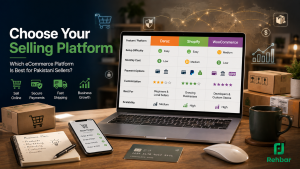
This is where most people spend too long debating. The honest answer is that your first choice doesn’t have to be permanent, but it does need to match your budget and skills right now.
Option A: Daraz (Best for Immediate Reach)
Daraz is the dominant marketplace in Pakistan. It handles your product listings, payments, and even parts of fulfillment if you use Daraz Fulfilled. You get access to millions of buyers without building your own traffic from scratch.
The trade-off is that Daraz takes a commission on every sale, your customer data belongs to Daraz, and you’re competing directly with other sellers on the same page as your product. You’re renting shelf space, not building an asset.
Best for: Sellers who want to test products fast, move existing inventory, or don’t want to manage a website.
Read More: How to Register NTN in Pakistan [Complete Guide]
Option B: Shopify (Best for Your Own Store)
Shopify is the leader for beginners and small to medium-sized businesses due to its all-in-one, user-friendly nature. You get a professional storefront, built-in payment tools, and integrations with local gateways like JazzCash and EasyPaisa.
Shopify’s themes are responsive and optimized for mobile devices — important given that over 60% of Pakistani shoppers buy via mobile. Pakistani customers often abandon carts if their preferred payment option is not available, so offering COD alongside digital wallets and cards is worth prioritizing.
Shopify’s basic plan starts at around $29/month (billed in USD). That’s a real cost when you’re starting out, but it’s the price of owning your own customer relationships.
Best for: Sellers building a brand who want full control over their store and customer data.
Option C: WooCommerce (Best for Control and SEO)
WooCommerce offers the best control for long-term search ranking power. It’s a free plugin for WordPress, which means your main costs are hosting (typically Rs. 1,500 to Rs. 5,000/month for decent local hosting) and a developer if you can’t set it up yourself.
WooCommerce requires technical expertise, and finding local payment integrations can be challenging. That said, Pakistani developers who specialize in WooCommerce are widely available on platforms like Upwork or through local agencies in Lahore and Karachi.
Best for: Sellers with a small budget who don’t mind a steeper setup curve and want SEO-friendly long-term growth.
The Smart Combination
Launch on Daraz in parallel to capture marketplace demand and new customer discovery. Sync inventory across channels, collect customer emails with post-purchase flows, and move repeat buyers to your owned store to grow lifetime value over time.
Read More: How to Start Amazon Business from Pakistan
Step 4: Sort Out Payments
Pakistani ecommerce has a payment culture problem that every seller has to plan around. Despite the sector’s growth, 75% of transactions still rely on cash payments. That means Cash on Delivery (COD) isn’t optional — it’s your primary payment method whether you like it or not.
Digital payments are growing quickly, with mobile wallets like JazzCash and Easypaisa leading the way. These wallets enable instant mobile payments through QR codes and USSD codes, making them convenient for both urban and rural users.
For your store’s payment setup, you’ll want:
A payment gateway: Safepay and PayFast are the most commonly used with Shopify in Pakistan. Most payment gateways charge between 2% and 3.5% per transaction as the Merchant Discount Rate (MDR). XPay integrates JazzCash, EasyPaisa, Raast, credit cards, and more in a single platform.
JazzCash and EasyPaisa integration: JazzCash has over 30 million registered users. If your target audience skews toward mass market or younger demographics, wallet coverage directly impacts your revenue.
COD with a reliable courier: Your courier partner collects the cash and remits it to you on a settlement cycle, typically weekly. Choose a courier with a transparent settlement process and fast reconciliation. T+1 settlement means your money arrives the next business day. T+3 means you’re effectively financing three days of inventory — a material difference in early growth stages.
Step 5: Set Up Logistics and Delivery
Delivery is where most new ecommerce businesses in Pakistan either build trust or destroy it. A late shipment or a damaged product is often enough to generate a return and a negative review that follows your store.
The main courier options for ecommerce sellers in Pakistan are:
| Courier | Strength | Best For |
| TCS | Wide coverage, international | Express and B2B shipments |
| Leopards | COD-focused, 1,500+ locations | Mass-market ecommerce |
| M&P (Muller and Phipps) | Competitive pricing | Mid-volume sellers |
| BlueEx | Urban delivery speed | Karachi and Lahore stores |
| PostEx / Trax | Fast COD settlement | High-volume sellers |
Trusted ecommerce logistics names in Pakistan include TCS, Leopards, BlueEx, Call Courier, Trax, PostEx, Rider, Swyft, and M&P. Negotiate rates based on volume and region, and share order data through APIs to reduce errors.
Leopards Courier has over 800 express centres and more than 1,500 service locations across Pakistan. It’s a popular choice for small and medium online businesses that want national COD coverage.
One practical tip: don’t start with a single courier. Test two or three simultaneously on your first 50 to 100 orders, tracking delivery times and your Return to Origin (RTO) rate. Your RTO rate is the percentage of orders that come back because the customer wasn’t available, changed their mind, or gave a wrong address. High RTOs are expensive. You can reduce returns by confirming orders through WhatsApp, offering flexible delivery windows, and using address validators at checkout.
Step 6: Build Your First Customers
You have a store, a product, and a way to ship it. Now you need people to find you.
TikTok and Instagram Reels: These are disproportionately effective for Pakistani ecommerce right now. A short video showing the product in use, an unboxing, or a before-and-after can generate hundreds of orders with zero ad spend if it gains traction. The algorithm favors content, not ad budgets.
Facebook and Instagram Ads: Pakistan’s cost-per-click on Facebook is relatively low compared to Western markets. A test budget of Rs. 5,000 to Rs. 10,000 is enough to learn whether an ad set converts. Start with a single product, a single audience, and a single creative split testing comes later.
WhatsApp as a sales channel: Pakistani buyers trust WhatsApp. Many sellers run significant volumes entirely through WhatsApp broadcast lists and status updates, with no formal website at all. As you grow, WhatsApp Business lets you set up a product catalogue, automated replies, and order tracking links.
Influencer marketing: Pakistan has a growing tier of mid-size content creators (100,000 to 500,000 followers) who charge far less than their Western counterparts and whose audiences are highly engaged. Use influencers who match your niche and request content rights for ads. Create UGC-style videos, unboxings, and before and after showcases.
Google SEO and Ads: Slower to build than social, but higher intent. Someone searching “buy leather wallet online Pakistan” is much closer to purchasing than someone scrolling TikTok. For a new store, Google Shopping ads can drive early traffic while your organic rankings develop.
Step 7: Understand Your Numbers
Most ecommerce businesses in Pakistan fail not because of bad products but because of bad unit economics. Know these figures before you scale.
Cost of Goods (COG): What you actually paid for each unit, including shipping from supplier.
Courier cost: Typically Rs. 180 to Rs. 350 for a standard parcel within a city; Rs. 250 to Rs. 500 intercity for under 1kg. COD charges add another Rs. 50 to Rs. 100 per order.
Return to Origin rate: If 20% of your orders come back, you’re paying twice for shipping and still holding unsold inventory. Getting this below 10% should be a priority.
Payment gateway fees: 2% to 3.5% per online transaction.
Customer Acquisition Cost (CAC): How much you spent on ads or marketing to get one paying customer. If your product sells for Rs. 1,500 with Rs. 500 cost of goods and Rs. 300 in courier fees, your remaining margin before ads is Rs. 700. If your CAC is Rs. 800, you’re losing money on every sale.
Run these numbers honestly before spending anything on marketing.
Frequently Asked Questions
Do I need a registered business to sell online in Pakistan?
You don’t legally need registration for very small-scale selling, but most payment gateways and courier companies with commercial accounts will ask for your NTN at minimum. Registration also protects you legally and lets you open a proper business bank account.
Can I start an ecommerce business in Pakistan with a small budget?
Yes. Many successful sellers started by sourcing 10 to 20 units of a product, selling through Daraz or WhatsApp, and reinvesting the profit before building a formal store. The actual launch cost on WooCommerce with local hosting can be under Rs. 20,000. The bigger variable is your marketing budget.
Is Daraz better than building your own Shopify store?
They serve different purposes. Daraz gives you access to buyers without building traffic from scratch. Shopify gives you a brand and customer relationships you own. The wisest move for most new sellers is starting on Daraz to validate the product, then running a Shopify store in parallel as you build your own audience.
What’s the biggest reason ecommerce businesses fail in Pakistan?
High return rates and bad unit economics. When 25% to 40% of COD orders come back undelivered, and sellers haven’t accounted for that cost in their pricing, the business bleeds cash. Confirm every order via WhatsApp before dispatch and price with RTO in mind.
Can I sell internationally from Pakistan?
Yes, but it’s a different business model. TCS and DHL both offer international shipping from Pakistan. For digital products or services, platforms like Etsy, Shopify with international shipping, or Amazon (with some complexity for Pakistani sellers) are options. The logistics cost is the main barrier for physical goods.
Pakistan’s ecommerce market is genuinely at an early enough stage that a focused seller with a good product and tight operations can still carve out a profitable business. The infrastructure is there. The buyers are there. What matters now is doing the foundational work right: legal registration, choosing the right platform for your stage, offering payment methods your customers actually use, and knowing your margins before you scale.
Start with one product, one channel, and fifty orders. Learn from those fifty before spending heavily on ads or expanding your catalogue.