

How to Register a Company in Pakistan: SECP Guide
Starting a business in Pakistan without registering it is like building a house on rented land. You’re exposed, unprotected, and cut off from things you’ll need later: a business bank account, investor funding, contracts with larger companies, and clean tax records.
The good news is that the process to register a company in Pakistan has genuinely improved. In July 2025, SECP reported 4,065 company registrations in a single month, with 99.9% of incorporations processed digitally. In May 2026, SECP announced it incorporated 4,082 companies in April 2026, the highest monthly incorporations recorded in Pakistan’s corporate history, bringing total registered companies to 294,101.
That momentum tells you something: more entrepreneurs in Pakistan are registering formally, and the system is working well enough that they’re doing it themselves online. This guide covers everything you need, from choosing the right business structure to what you must do after receiving your incorporation certificate.
Choose Your Business Structure First
Before you touch the SECP portal, decide what type of entity you’re forming. The wrong structure costs you more money and creates the wrong legal setup from day one.
Pakistan has several main business registration types. A sole proprietorship is the simplest form, owned by one individual, and requires NTN registration with FBR but does not involve SECP at all. A partnership or Association of Persons (AOP) is for two or more individuals running a business together, requiring partnership documentation and FBR registration. A Private Limited Company is a separate legal entity registered with SECP.
Read More: How to File Tax Return Yourself in Pakistan [Step by Step]
Here’s a practical comparison:
| Structure | Registered | Minimum Members | Liability | Best For |
| Sole Proprietorship | FBR (NTN only) | 1 | Unlimited | Freelancers, solo traders |
| Partnership / AOP | FBR | 2 | Unlimited | Small family businesses |
| Single Member Company (SMC) | SECP | 1 | Limited | Solo founders wanting protection |
| Private Limited Company (Pvt Ltd) | SECP | 2 (max 50) | Limited | Startups, growing businesses |
| Public Limited Company | SECP | 3+ | Limited | Entities seeking public investment |
A Single Member Company (SMC) is ideal for solo entrepreneurs who want the benefits of limited liability protection while running independently. A Private Limited Company is a good choice for founders who want to keep the business within a close circle of partners, family, or co-founders, with a maximum of 50 shareholders.
Most startups, freelancers formalising their work, and small business owners go with a Private Limited Company or an SMC. Both offer limited liability, meaning your personal assets are separate from business debts.
What Limited Liability Actually Means
This distinction matters more than most first-time founders realise. With a sole proprietorship, if your business takes on debt it can’t repay, creditors can come after your personal savings, car, or property. With a Private Limited Company or SMC, your personal liability is limited to the capital you’ve put into the company. Your house stays your house.
This is the primary reason experienced entrepreneurs favour SECP registration even when the business is small.
Read More: Top Export Products of Pakistan and Exports by Cities [Updated]
Step-by-Step: How to Register a Company in Pakistan Online
The entire process happens through SECP’s official eZfile portal at eservices.secp.gov.pk. You don’t need to visit an office for most company types.
Step 1: Create accounts on the SECP LEAP/eZfile portal
After entering your name, father’s name, address, email, CNIC number, and mobile number, SECP sends verification codes to your email and mobile number. Enter the codes and your account is created. Your CNIC or passport number becomes your login ID.
One important detail that trips up founders: you need to create LEAP accounts for all directors and shareholders of the proposed company in the same way before submitting the application. If you have two directors and two shareholders (which could be the same people), all four individuals need accounts before you can complete the registration form.
Step 2: Choose your company name
You must propose three business names in order of preference. The SECP registrar will approve one name based on availability and compliance with legal requirements.
Check name availability first using SECP’s name search tool on their website. SECP charges Rs 200 (plus any bank fees) to reserve a name. The name reservation remains valid for a period allowing you to complete the incorporation process.
Avoid names that are identical or deceptively similar to existing registered companies, names that include words like “government,” “national,” “federal,” or “authority” without special permission, and names that are offensive or misleading.
Step 3: Prepare your Memorandum and Articles of Association
The Memorandum of Association (MoA) details your business sector and objectives. The Articles of Association govern how the company is internally run.
SECP provides template documents for standard company types. For most Private Limited Companies, the standard templates work fine. If your business has unusual structures (special share classes, complex voting rights, etc.), consult a corporate lawyer before filing.
Step 4: Complete the online incorporation form
In the form, enter the CNIC number, full name, father’s name, residential addresses, mobile number, and email address of all directors and shareholders, including the CEO. Include the face value of shares and the number of shares taken by each director. The form will auto-calculate the total paid-up capital. You’ll also add the company name, registered office address, principal line of business, email, website, and telephone.
SECP gives you an option to register with EOBI (Employees Old-Age Benefits Institution) and the Social Security Institute at this stage, so the form asks for information twice for both the company and these third-party registrations.
Read More: How to Start Online Business in Pakistan?
Step 5: Pay the registration fee
The SECP company registration fee for online filing starts at Rs 2,200 when the authorised capital is up to Rs 100,000. For offline filing, the equivalent fee is Rs 5,000. The fee increases as authorised capital rises, with additional charges per Rs 100,000 above the initial limit.
The difference between online and offline fees is significant. Online filing consistently costs less and processes faster, so there’s no reason to file physically unless you have a specific reason to.
Step 6: Submit and receive your Certificate of Incorporation
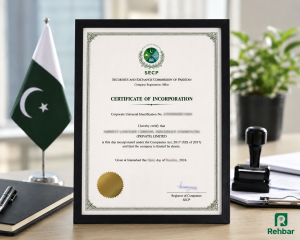
The process usually takes 1 to 3 working days, depending on documentation accuracy. Once SECP approves your application, you receive a Certificate of Incorporation, which is your proof that the company legally exists as a separate entity.
SECP Registration Fees at a Glance
| Authorised Capital | Online Fee | Offline Fee |
| Up to Rs 100,000 | Rs 2,200 | Rs 5,000 |
| Rs 100,001 to Rs 500,000 | Rs 4,000+ | Higher |
| Name Reservation | Rs 200 | Rs 200 |
| Not-for-Profit (Section 42) | Rs 27,500 | Rs 55,000 |
Fee schedules are updated periodically. Check the current schedule on SECP’s official website at secp.gov.pk before filing.
Total out-of-pocket cost for a typical Private Limited Company with Rs 100,000 authorised capital, filed online, runs approximately Rs 10,000 to Rs 15,000 when you include the SECP fee, name reservation, company stamp, NTN registration, and MOA printing. One Islamabad-based founder shared they paid Rs 12,000 total, which included EOBI, NTN, stamp, and professional advisory support for a small Private Limited Company.
Read More: How to Register NTN in Pakistan [Complete Guide]
What to Do After SECP Incorporation
Getting your Certificate of Incorporation is not the finish line. A registered company that hasn’t completed the post-incorporation steps can’t legally operate, can’t open a bank account, and isn’t tax-compliant.
Get Your NTN from FBR
After SECP registration, a company must register with the Federal Board of Revenue (FBR) for an NTN, tax filing, and sales tax, if applicable.
The NTN (National Tax Number) is your company’s identity with Pakistan’s tax authority. Register at fbr.gov.pk using your Certificate of Incorporation, company CNIC details, and registered office address. NTN registration is free and typically completes within a day.
Open a Business Bank Account
Banks require your Certificate of Incorporation, NTN, CNICs of directors, and a Board Resolution to open a business bank account. The Board Resolution is a formal document, signed by directors, authorising the account opening and specifying who has signing authority.
Most major Pakistani banks (HBL, MCB, Meezan, UBL) have a dedicated corporate banking team for company account openings. Meezan Bank and HBL are commonly used by startups for their straightforward documentation processes.
Register for Sales Tax (if applicable)
If your annual turnover exceeds PKR 10 million or you deal in taxable goods or services, register for Sales Tax with FBR. For services-based businesses, also register with the relevant provincial revenue authority: PRA (Punjab), SRB (Sindh), KPRA (KPK), or BRA (Balochistan).
Annual SECP Compliance
Private Limited Companies must file annual accounts with SECP within 30 days of the Annual General Meeting (AGM). Form-A (Annual Return) is required for private companies. Missing these filings leads to penalties and can eventually result in the company being struck off the register.
Many founders are unaware of this ongoing compliance requirement when they register. Put the annual filing date in your calendar from day one.

Sole Proprietorship vs Private Limited Company: Which Is Right for You?
This is the question most people are really asking when they search for how to register a company in Pakistan.
A sole proprietorship is simpler, cheaper, and requires no SECP involvement. You register with FBR, get your NTN, and you’re operational. But you have unlimited personal liability, and many B2B clients, government contracts, and investor relationships require a formal SECP-registered entity.
A Private Limited Company costs more upfront and has ongoing compliance requirements, but it gives you limited liability, a separate corporate identity, a proper bank account, and the ability to bring in investors through share issuance.
The practical test: if you’re freelancing, running a small shop, or doing consulting work with personal clients, a sole proprietorship is fine. If you’re building a business that will hire employees, take on contracts with larger companies, or raise investment, register a Private Limited Company from the start.
Registering as a Foreign National or Non-Resident
Pakistan allows foreign nationals to register companies. SECP provides a fully digital platform to incorporate your business, whether you’re forming a Single Member Company, a Private Limited Company, or a Public Limited Company.
Foreign nationals use their passport number as their login ID on the SECP portal rather than a CNIC. The documentation requirements are similar, with a passport copy substituting for the CNIC where required. Foreign-owned companies may also need additional approvals from the Board of Investment (BOI) depending on the sector.
Common Mistakes That Delay or Complicate Registration
Choosing a name without checking availability. Name conflicts are one of the most common rejection reasons. Always search the SECP company name database before investing time in the application.
Forgetting to create LEAP accounts for all directors. Each director and shareholder needs their own SECP account before the application can be completed. Discovering this midway through the form wastes time.
Setting authorised capital too low or too high. Authorised capital is not the money you need to start. It’s the maximum amount of shares your company can issue. Setting it too high means higher SECP fees; setting it too low limits your ability to raise investment later. Rs 100,000 to Rs 500,000 is typical for most small businesses.
Ignoring post-registration compliance. A company that doesn’t get its NTN, doesn’t open a proper bank account, and doesn’t file annual returns eventually becomes non-compliant. SECP can strike off companies that fail to meet their statutory obligations.
FAQ
How long does it take to register a company in Pakistan?
The process usually takes 1 to 3 working days from submission, depending on documentation accuracy. The total timeline from starting your application to having your bank account open is typically 5 to 10 business days.
Do I need a lawyer to register a company with SECP?
No. SECP already has a published user guide, incorporation videos, FAQs, and eZfile manuals available on their portal. You can register your company yourself. Many founders do this without professional help. Hiring a consultant is worth considering if you have an unusual structure, multiple foreign shareholders, or limited time.
What is the minimum capital required to register a company in Pakistan?
There is no minimum paid-up capital requirement for most private limited companies in Pakistan under the Companies Act 2017. Your authorised capital can be as low as Rs 100,000, which is what most small companies start with.
Can one person register a company in Pakistan?
Yes. A Single Member Company (SMC) allows one person to be both the sole director and sole shareholder while enjoying limited liability protection. This is the right structure for solo founders who want the benefits of corporate registration.
Is a sole proprietorship registration done through SECP?
No. A sole proprietorship is the simplest form of business, requiring NTN registration with FBR but not involving SECP at all.
What is the difference between authorised capital and paid-up capital?
Authorised capital is the maximum share value your company is permitted to issue. Paid-up capital is what has actually been invested by shareholders. Your authorised capital sets the ceiling; paid-up capital is the actual amount.
Company registration in Pakistan is genuinely manageable if you know which structure fits your situation, prepare your documents before touching the SECP portal, and create accounts for all directors upfront. The entire process can be completed online in a few days. The bigger ongoing commitment is annual compliance, so build that into your business calendar from the start and you’ll stay on the right side of both SECP and FBR.