Best Ways to Send Money to Pakistan
Disclaimer: Exchange rates, fees, and provider rankings referenced here change daily and different comparison sites often disagree on which provider is cheapest at any given moment. Always compare live rates on the day you send rather than relying on a fixed recommendation from this or any article.
Search “best way to send money to Pakistan” and you’ll find a dozen sites each confidently naming a different winner. That’s not because most of them are wrong. It’s because the cheapest option changes daily depending on the exchange rate, your transfer amount, and which currency you’re sending from. What actually stays constant is the framework for comparing your options, and that’s what’s worth understanding rather than memorizing one provider name.
Pakistan received $38.3 billion in remittances in fiscal year 2025, with the US, Saudi Arabia, UAE, and UK accounting for most of that volume. Here’s how bank transfers, exchange companies, and remittance apps actually compare, and what determines which one wins for your specific transfer.
Read: Roshan Digital Account 2026 Guide for Overseas Pakistanis
The Number That Actually Matters
Every transfer has two costs, and providers often advertise only one of them.
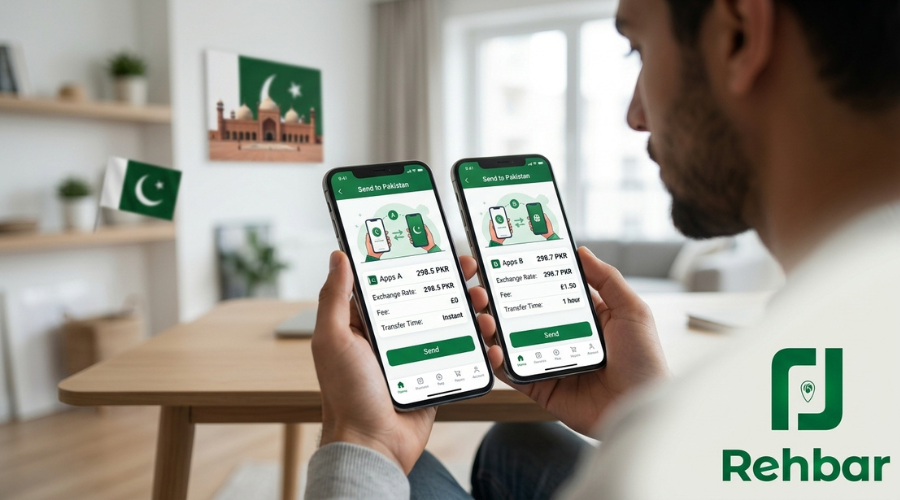
The first is the visible fee, a flat charge or percentage shown upfront. The second, and the one that costs people the most without them noticing, is the exchange rate markup. Providers buy currency at the mid-market rate, the real rate you’d see on a currency converter, then add a margin before quoting you their rate. A service advertising “zero fees” can still cost you far more than a competitor charging a small fee but using a rate closer to the mid-market number.
The only reliable way to compare is checking the total Pakistani rupees your recipient actually gets for a given amount, not the fee or the rate in isolation.
Bank Transfers
Sending through your own bank or a wire transfer service is the most familiar option, especially for larger or one time transfers, but it’s rarely the cheapest for regular remittances.
What works in its favor:
- High trust and familiarity, especially for larger amounts
- Useful for transfers tied to specific purposes, such as funding a Roshan Digital Account, where the transaction needs to run through a documented banking channel
- No need to create a new account with a separate provider
Read: Filer vs Non-Filer Status for Overseas Pakistanis 2026
What works against it:
- Traditional banks often build in exchange rate markups reported anywhere from roughly 2 to 4 percent, well above what specialist providers typically charge
- Wire fees on the sending end can run $25 to $45 for smaller amounts, making a bank transfer uneconomical for anything but larger sums
- Delivery can take longer than app based alternatives, sometimes several business days
Banks tend to make the most sense for large transfers, particularly ones connected to formal investment channels like an RDA, where the banking relationship itself matters more than shaving a percentage point off the rate.
Read: How Overseas Pakistanis Can Buy Property Remotely
Exchange Companies
This category covers licensed money changers and services like Western Union or MoneyGram that offer cash pickup at physical locations across Pakistan.
What works in its favor:
- Reaches recipients without a bank account or smartphone, including rural areas where digital options may not be practical
- Cash pickup happens quickly once a transfer is sent, often within minutes to hours
- Widest physical network of any option, useful if your family lives somewhere without reliable digital infrastructure
What works against it:
- Exchange rate margins vary widely between providers and even day to day, with reported spreads of several percentage points between the best and worst rates on the same route
- Fees for cash pickup can add up compared to app based bank or mobile wallet delivery
- Requires your recipient to physically visit a pickup location
If your family doesn’t use mobile banking or a digital wallet, this remains the most practical option despite generally costing more than app based alternatives.
Read: Power of Attorney for Property: Overseas Pakistanis Guide
Remittance Apps
This is where most of the genuine competition happens, and where comparison sites disagree with each other most often. Wise is frequently cited for using the mid-market rate with a transparent fee, typically reported between roughly 0.4 and 1.5 percent. Other providers, including Remitly, TapTap Send, LemFi, and ACE Money Transfer, get named as cheapest or fastest depending on which comparison site you check and which day you check it.
What works in their favor:
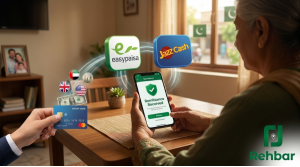
- Deliver directly to mobile wallets like Easypaisa and JazzCash, often within minutes, with no bank account required on the recipient’s end
- Rate transparency has improved across the industry, with several providers now showing the mid-market rate alongside their own quoted rate
- Lower fees than banks for small to mid sized transfers in most cases
What works against them:
- Rankings genuinely shift day to day based on live exchange rates, so a provider that’s cheapest this week may not be next week
- Some providers charge a flat fee on smaller transfers that changes the math, so a provider with a better headline rate can still cost more on a $50 transfer than one with a flat low fee
- Not all providers operate in every sending country, so availability depends on where you’re transferring from
Read: Can Overseas Pakistanis Vote in Pakistan Elections
Comparing the Three at a Glance
| Method | Best for | Typical delivery time | Main cost driver |
| Bank transfer | Large or formal transfers, RDA funding | 1 to 3 business days | Exchange rate markup, wire fees |
| Exchange company | Recipients without bank or mobile wallet access | Minutes to hours | Rate spread, pickup fee |
| Remittance app | Regular transfers to mobile wallets or bank accounts | Minutes to same day | Combination of flat fee and rate margin |
What to Avoid
Informal hawala or hundi networks sometimes advertise better rates than any licensed provider, and it’s worth being direct about why that’s not a reasonable tradeoff. These channels operate outside regulated banking oversight, offer no recourse if funds go missing, and carry legal risk on both ends of the transaction. The exchange rate advantage, where one exists, doesn’t offset the total absence of protection if something goes wrong.
Read: Dual Nationality Pakistan Allows: Full Country List
How to Actually Compare Before You Send
- Check the live mid-market rate for your currency pair using any neutral currency converter before opening a transfer app.
- Compare total PKR delivered, not the advertised fee or rate alone, across two or three providers for your exact transfer amount.
- Factor in your recipient’s setup. A slightly better rate doesn’t help if your family can’t easily access that provider’s payout method.
- Send larger amounts less often if a provider charges a flat minimum fee. Several smaller transfers can cost more in cumulative fees than one larger one.
- Set a rate alert if your timing is flexible. Exchange rates move daily, and waiting for a favorable swing can meaningfully change what your family receives on a larger transfer.
Read: POC vs NICOP: Which One Do You Actually Need?
Frequently Asked Questions
Is remittance income to Pakistan taxable?
No. Money sent home to family is not treated as taxable income under Pakistani tax law. Some sending countries have separate reporting thresholds for large transfers, which is a rule about your home country’s tax authority tracking large transactions, not about Pakistan taxing the remittance itself.
Which provider is actually cheapest?
It depends on the day, your sending country, your transfer amount, and how your recipient wants to receive the funds. Multiple comparison sites rank different providers as cheapest because rates shift daily, so compare live numbers for your specific transfer rather than trusting a fixed recommendation.
Can I send money directly to Easypaisa or JazzCash from abroad?
Yes. Most major remittance apps support direct delivery to these mobile wallets, often within minutes, using just the recipient’s registered mobile number.
Is it safe to use apps instead of a bank?
Regulated, licensed remittance apps operate under the same anti-fraud and anti-money-laundering requirements as banks in most sending countries. Checking that a provider is licensed in your country before you register is worth the extra two minutes.
Should I use a bank for large transfers instead of an app?
For very large transfers, particularly ones tied to formal investment like a Roshan Digital Account, a bank transfer often makes more sense despite potentially costing more in rate markup, since the banking relationship and documentation trail matter more than the small percentage difference.
The most useful habit here isn’t picking one provider forever. It’s comparing live rates for your specific amount and route each time you send, since the “best” option genuinely changes from one week to the next.