How to Receive International Payments in Pakistan
Disclaimer: This article covers financial and tax-related topics. Fees, exchange rates, and regulations change frequently. Verify current rates with the relevant platforms and consult a qualified Pakistani tax professional before making financial decisions.
You finished the project. The client clicked “Pay.” And then the real stress started.
For millions of Pakistani freelancers and remote workers, that moment between “payment sent” and money actually arriving in your pocket is one of the most expensive parts of the job. Hidden correspondent bank fees, weak exchange rates, and days of waiting can quietly swallow 10 to 15 percent of what you earned. The good news is that the options available in Pakistan right now are genuinely better than they’ve ever been.
Pakistan’s IT and IT-enabled services exports hit a record $3.8 billion in fiscal year 2025, an 18 percent jump over the previous year. Freelance and remote-work remittances specifically surged 90 percent year-on-year, reaching $779 million. That’s a lot of people figuring out how to get paid across borders, and the platforms have taken notice.
This guide breaks down every method that actually works right now, what each one costs you, and how to set up a payment flow that keeps more of your money in your account.
Read More: How to Create PayPal Account from Pakistan
Why PayPal Still Doesn’t Work (and What You Should Use Instead)
PayPal has been available in Pakistan since 2018, but only in a limited capacity. You can send money and make purchases, but you cannot receive payments directly into a Pakistani account. That means if you’re on Upwork or Fiverr, your clients cannot send you earnings through PayPal if you’re based in Pakistan.
The good news is that the alternatives are legitimately better for most use cases, lower fees, faster delivery, and friendlier exchange rates. Here’s what actually works.
Method 1: Payoneer
Payoneer remains the most widely used platform for receiving international payments in Pakistan, and for good reason. It gives you virtual bank accounts in USD, EUR, and GBP, which means platforms like Upwork, Fiverr, and Amazon can pay you as if you were a local US or European account holder. For marketplace freelancers, this alone makes Payoneer non-negotiable.
What Payoneer Costs in 2026
Payoneer implemented a significant fee hike for Pakistani users, introducing a 3% withdrawal fee, a 50% increase over the previous 2% rate.
Here’s what the current structure looks like:
| Transaction Type | Fee |
| Withdrawal to Pakistani bank (foreign currency) | 3% |
| Transfer to third-party bank account | 3% |
| Payoneer-to-Payoneer (above $500) | 0.60% |
| Transfers under $100 (receiving) | $1 flat |
| Transfers above $100 (receiving) | 1% |
| Annual account/card fee | $29.95 |
| ATM withdrawal | $3.15 per transaction |
These changes apply to individuals, freelancers, and registered companies operating through Payoneer in Pakistan.
The 3% stings, but there’s a smart workaround. Rather than withdrawing from Payoneer directly to a traditional bank, link your SadaPay or NayaPay IBAN to your Payoneer account instead. You’ll still pay the Payoneer withdrawal fee, but you’ll get the fintech bank’s exchange rate, which is generally better than what traditional banks offer, saving you thousands over time.
Best for: Anyone getting paid through Upwork, Fiverr, or Amazon. There’s no real substitute here.
Method 2: SadaPay
SadaPay is one of the most freelancer-friendly products to come out of Pakistan’s fintech boom. It’s a fully licensed digital bank regulated by the State Bank of Pakistan, and it gives you a real IBAN and SWIFT code you can share directly with overseas clients.
SadaPay is widely considered the easiest way to bill direct clients and receive international payments in Pakistan. Their SadaBiz product is specifically built for this, you can send clients a payment link and get paid in foreign currency with the money arriving in PKR at a competitive rate.
SadaPay charges a straightforward 1.5% currency conversion fee. There are no hidden correspondent bank charges eating into your transfer the way traditional SWIFT wires often do.
SadaPay directly supports Payoneer withdrawals and allows easy access to funds with a Mastercard that works internationally. If you earn through platforms, this makes SadaPay an excellent “last mile” account where you park funds before spending or converting.
Best for: Freelancers with direct clients who can send wire transfers, and anyone who wants to link a better-rate account to their Payoneer.
Read More: How to Start Ecommerce Business in Pakistan
Method 3: NayaPay
NayaPay takes a slightly different approach. It’s a solid app for managing finances and international spending, functioning more like a complete financial ecosystem than just a payment receiver.
NayaPay, armed with its super-app ambitions, offers a toolbox for the ambitious. It handles utility bill payments, credit card settlements, Raast transfers, and comes with a Visa debit card.
NayaPay gives you the option to let Visa handle the currency conversion rate when making international purchases. In practical terms, the PKR amounts you end up paying on international subscriptions like Netflix or Spotify are nearly identical across NayaPay and SadaPay.
NayaPay’s Visa card may provide better online acceptance for subscriptions like Coursera, Netflix, or Spotify.
Best for: Freelancers who want an all-in-one digital bank for both receiving payments and managing day-to-day finances locally.
Method 4: Wise
Wise (formerly TransferWise) has become increasingly popular for receiving international payments because of one thing: the mid-market exchange rate with no hidden markups.
Wise uses the mid-market exchange rate and always shows fees upfront. For someone receiving $1,000 from a client abroad, the cheapest route via Wise costs around $6.29.
Compare that to a traditional Pakistani bank: through a typical Pakistani bank, you’re looking at a 3 to 4 percent exchange rate markup on top of a fixed fee of PKR 500 to 2,000. On a PKR 100,000 transfer, you’re handing over an extra PKR 3,500 to 6,000 in costs you’ll never see itemised on a receipt.
Pakistani residents can open a Wise account, receive payments in EUR, GBP, or USD, and send money abroad. For PKR-to-USD transfers, you’re typically looking at 0.5 to 1.5% of the transfer amount.
One important note: Wise works best when the person sending you money is the one using Wise. As a receiver in Pakistan, you get the money deposited directly to your local bank account. There’s no cash pickup option.
Best for: Direct clients who are comfortable using Wise to send payment, and larger transfers where the mid-market rate advantage becomes most significant.
Method 5: Traditional Bank Transfers (SWIFT/IBAN)
Your HBL, UBL, Meezan, or Bank Alfalah account can receive international wire transfers. This remains the preferred route for corporate clients and larger B2B payments where the sending company’s finance department requires a formal bank account.
Traditional bank transfers can take 3 to 5 business days and often involve high fees, both for the sender and receiver. Exchange rates may not be competitive.
The real cost is usually buried in the exchange rate. Banks apply a spread on top of the interbank rate, and correspondent bank fees can deduct another $15 to $35 from your transfer before it arrives. For a $500 freelance payment, that’s a meaningful chunk.
The only time you should use a traditional bank is if a massive, old-school corporate client’s finance department refuses to use anything else. For individual freelancers, the fintechs (SadaPay, NayaPay) and Payoneer will almost always serve you better.
Tip: Always give clients your full IBAN to prevent routing errors that delay transfers.
Read More: How to Become a Freelancer Without Experience
Method 6: Western Union and MoneyGram
Western Union offers $0 transfer fees for transfers above $200 to qualifying Pakistani bank accounts, though they make money on the exchange rate. Their featured payout partners in Pakistan include Meezan Bank, HBL, UBL, and Allied Bank, with over 13,000 agent locations for cash pickup throughout Pakistan.
Money Transfer Operators like Western Union, MoneyGram, and Ria offer fast transfers — often same-day or within minutes. No need for a bank account in some cases.
These services make the most sense for family remittances or one-off personal transfers, not for regular professional payments. The exchange rate margins can be unfavorable compared to Wise or fintech alternatives.
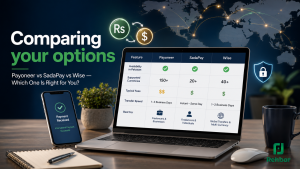
Comparing Your Options: A Quick Summary
| Method | Best For | Typical Fee | Speed |
| Payoneer | Upwork/Fiverr freelancers | 3% withdrawal | 1-2 days |
| SadaPay (SadaBiz) | Direct client billing | 1.5% conversion | 1-2 days |
| NayaPay | All-in-one digital banking | Visa rate | 1-2 days |
| Wise | Larger direct transfers | ~0.5-1.5% | Minutes to 2 days |
| Traditional banks | Corporate/B2B clients | 3-5% effective | 3-5 days |
| Western Union | Family remittances | FX margin | Minutes |
The Tax Side: What Pakistani Freelancers Need to Know
Getting paid is only part of the equation. Understanding how that income is taxed determines how much you actually keep.
PSEB-registered freelancers pay only 0.25% tax on foreign remittance received through approved banking channels — one of the best tax rates available anywhere. Without PSEB registration, the rate is 1% on export receipts. That’s a 75% reduction just for registering with the government’s Pakistan Software Export Board.
There’s a rule that trips up many freelancers: to maintain access to the low export tax rates, at least 80% of your foreign income must be received in Pakistan through approved banks during the tax year. Leaving most of your earnings sitting in Wise or international accounts puts you at risk of losing the favorable rate.
Every Pakistani freelancer must complete two essential registrations: FBR Registration to get your National Tax Number (NTN), and PSEB Registration to qualify for the 0.25% tax rate.
Both registrations are free and done online. The savings are real. On $30,000 in annual income, the difference between 1% and 0.25% tax works out to roughly $225, not transformative, but zero reason to leave it on the table.
Tax laws in Pakistan change regularly. Consult a qualified Pakistani tax professional to verify current rates and obligations before filing.
Read More: How to Make Money Without Investment
The Roshan Digital Account: For Non-Resident Pakistanis
If you’re a Pakistani living abroad, there’s a specific option worth knowing about. Launched in September 2020, the Roshan Digital Account lets non-resident Pakistanis open bank accounts online, invest in Naya Pakistan Certificates, and trade on the Pakistan Stock Exchange without visiting Pakistan in person. By early 2026, total RDA inflows had reached $12.426 billion, with 917,400 accounts registered since the scheme launched.
The HBL Roshan Digital Account can be opened in Pakistani Rupees or in a foreign currency, and can only be funded by money sent from outside Pakistan. There’s no minimum balance requirement.
This is specifically for overseas Pakistanis who want to send money home while retaining some control over how it’s held and invested.
The Smartest Payment Setup for Freelancers
Based on how things work right now, here’s the setup that makes the most sense for the majority of Pakistani freelancers:
If you work on platforms (Upwork, Fiverr, Amazon):
- Keep your Payoneer account active — it’s how you get paid from these platforms
- Link your SadaPay or NayaPay IBAN to Payoneer as the withdrawal destination
- Pay the 3% Payoneer withdrawal fee but capture the better fintech exchange rate
- Transfer funds to your traditional bank account only when needed
If you have direct clients:
- Share your SadaBiz (SadaPay) or NayaPay IBAN and SWIFT code directly
- Ask clients to send a wire transfer — the money lands with minimal deductions
- For clients who prefer a digital platform, Wise from their end is an excellent option
Frequently Asked Questions
Can Pakistanis receive payments through PayPal?
No. Pakistani residents cannot receive payments into a Pakistani account via PayPal. You can make purchases and send money, but incoming freelance payments are blocked. Payoneer, SadaPay, and Wise are the practical alternatives.
What is the cheapest way to receive international payments in Pakistan?
For direct client payments, sharing your SadaPay IBAN directly keeps costs to the 1.5% conversion fee. For marketplace platforms, Payoneer is the only real option, though linking it to a fintech account helps you capture a better exchange rate.
How long does an international wire transfer take to reach a Pakistani bank?
Traditional SWIFT transfers take 3 to 5 business days. Fintech platforms like SadaPay and NayaPay typically receive the funds in 1 to 2 business days. Wise transfers on popular corridors can arrive in minutes.
Do I need to declare my international freelance income in Pakistan?
Yes. Pakistani freelancers earning over PKR 600,000 annually must file an income tax return with the FBR. Even below that threshold, filing is recommended to stay on the Active Taxpayer List (ATL), which affects your withholding tax rates across dozens of transactions.
Is cryptocurrency a viable option for receiving payments in Pakistan?
Pakistan’s cryptocurrency regulatory position remains uncertain. The Pakistan Virtual Assets Regulatory Authority (PVARA) was established in 2025 via the Virtual Assets Ordinance, but the State Bank of Pakistan maintains that crypto is not legal tender and banks are prohibited from processing crypto transactions. Most freelancers avoid it unless their clients specifically work in the blockchain industry.
What is the Roshan Digital Account?
It’s a State Bank of Pakistan initiative that lets overseas Pakistanis open a bank account remotely and invest in Pakistani financial instruments. It’s not for resident Pakistanis receiving freelance income.
The options available to Pakistani freelancers in 2025 and 2026 are meaningfully better than what existed even three years ago. SadaPay and NayaPay have changed what “receiving a payment” actually feels like — less bureaucracy, faster settlement, better rates. The main work on your end is picking the right combination for your specific situation, registering with PSEB if you’re an IT freelancer, and making sure your payment flow keeps you on the right side of FBR’s 80% repatriation rule.