
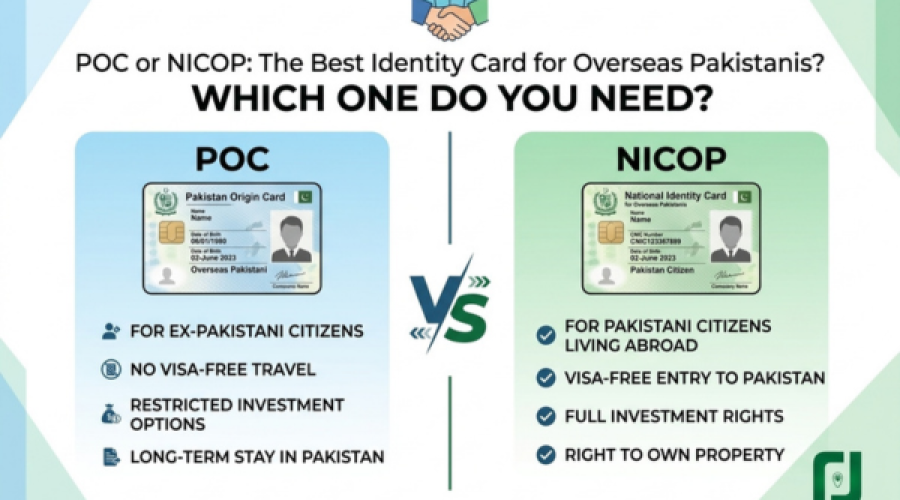
POC vs NICOP: Which One Do You Actually Need?
Disclaimer: Fees, processing times, and eligibility rules for NICOP and POC change periodically and figures reported across sources sometimes conflict. The numbers below are illustrative estimates for 2026. Confirm current fees and requirements on NADRA’s official Pak Identity portal before you apply.
Two acronyms confuse almost every overseas Pakistani at some point: NICOP and POC. Both come from NADRA, both let you enter Pakistan without a visa, and both show up in the same conversations about property, banking, and inheritance. The card you actually need comes down to one question: are you still a Pakistani citizen or not. Here’s how NICOP and POC differ, who qualifies for each, and what you gain or lose depending on which one you hold.
The One Question That Decides This
If you’re still a Pakistani citizen, even as a dual national, you need a NICOP. If you gave up Pakistani citizenship to take another country’s nationality, or you were never a Pakistani citizen but have Pakistani ancestry, you need a POC instead.
That’s the entire decision in one sentence. Everything else, fees, validity periods, what rights each card carries, follows from that single citizenship question.
What NICOP Actually Is
NICOP stands for National Identity Card for Overseas Pakistanis. It’s issued to Pakistani citizens living abroad, including dual nationals, and functions as the overseas equivalent of the CNIC that resident Pakistanis carry.
A NICOP holder keeps full citizen rights. Without a valid NICOP you cannot buy or sell property in Pakistan, open a bank account, claim inheritance, vote in elections, or open a Roshan Digital Account. That list alone explains why most overseas Pakistanis treat renewing an expiring NICOP as urgent rather than optional.
Who qualifies for a NICOP:
- Pakistani citizens living abroad, including dual nationals
- Applicants generally need either citizenship of a country Pakistan recognizes for dual nationality, or proof of foreign residency status such as a Green Card, an Indefinite Leave to Remain card, or a residence permit valid for at least six months
- Children born abroad to Pakistani parents, who can get a Juvenile NICOP
What POC Actually Is
POC stands for Pakistan Origin Card. It exists for people connected to Pakistan by origin or ancestry who are not currently Pakistani citizens.
Who qualifies for a POC:
- Former Pakistani citizens who renounced citizenship under Section 14B of the Pakistan Citizenship Act to take up another country’s nationality that doesn’t allow dual nationality with Pakistan
- People whose father or grandfather held Pakistani citizenship, even if they themselves were never Pakistani citizens
- Spouses of Pakistani citizens or POC holders who haven’t acquired Pakistani citizenship themselves
- Minor children of POC holders
The POC recognizes a connection to Pakistan without restoring citizenship. It grants a meaningful set of rights, including the right to own property, hold bank accounts, and reside for extended periods, but it stops short of the full rights bundle a citizen gets.
Where the Two Cards Actually Differ
| Feature | NICOP | POC |
| Who it’s for | Pakistani citizens living abroad | Foreign nationals of Pakistani origin |
| Citizenship status | Retains Pakistani citizenship | Does not hold Pakistani citizenship |
| Voting rights | Yes, subject to overseas voter rules | No |
| Property ownership | Full rights | Allowed, with some category restrictions such as agricultural land |
| Banking access | Full access, including foreign currency accounts | Allowed, including foreign currency accounts |
| Roshan Digital Account eligibility | Yes | Yes |
| Visa free entry to Pakistan | Yes | Yes |
| Typical validity | 7 to 10 years depending on the option chosen | Typically 7 years |
The voting line is worth sitting with. A POC lets you invest, own property, and live in Pakistan for extended stretches, but it does not carry political rights, since you’re legally a foreign national holding a document that recognizes your heritage rather than your citizenship.
What Each Card Costs
Reported fees vary depending on which processing speed you choose and which country zone you apply from, and different sources publish slightly different numbers, so treat the following as a rough guide rather than a fixed price.
For NICOP applications from Zone A countries such as the United States, United Kingdom, and most of Europe, normal processing has been reported around $12 to $20, with urgent and executive processing running higher. Applicants in the UAE and Gulf countries generally pay in local currency, with figures reported in the range of AED 75 to AED 150 depending on processing speed. Applying from inside Pakistan runs in Pakistani rupees, with normal processing reported around Rs. 5,500 and executive processing considerably higher.
POC fees follow a similar zone based structure to NICOP, though exact figures move often enough that checking NADRA’s current fee schedule before applying is worth the extra five minutes.
How to Apply for Either Card
- Confirm your citizenship status first. This determines which card you’re even eligible for, so don’t skip this step.
- Register on NADRA’s Pak Identity portal, id.nadra.gov.pk, or book an appointment at your nearest Pakistani embassy, high commission, or consulate.
- Gather your documents. For NICOP, this typically means your Pakistani or expired Pakistani passport, foreign passport or residency document, parents’ CNIC or NICOP details, and proof of your current foreign address. For POC, you’ll need documentation of prior Pakistani citizenship or ancestry, evidence of citizenship renunciation if applicable, and your current foreign passport.
- Complete biometric verification. Most applicants do this at a consulate or NADRA registration center, though the online route has reduced how much needs to happen in person.
- Pay the applicable fee based on your country zone and chosen processing speed.
- Wait for processing and delivery. Turnaround has been reported anywhere from about a week to a month depending on processing tier and location.
Which One Do You Actually Need
A few common scenarios make this easier to place yourself in:
You’re a dual national who still holds Pakistani citizenship. You need a NICOP. This covers most second generation Pakistani professionals living in countries like the UK, US, Canada, and the Gulf who never formally gave up citizenship.
You gave up Pakistani citizenship to naturalize somewhere that doesn’t allow dual nationality with Pakistan. You need a POC. Several countries fall into this category, so if you’re unsure whether your new citizenship required renouncing Pakistani nationality, check with NADRA or your consulate rather than assuming.
Your parents or grandparents were Pakistani but you were born abroad and never held Pakistani citizenship yourself. You need a POC, and it’s the document that formally connects you back to Pakistan for property, banking, and residence purposes.
You’re a foreign spouse of a Pakistani citizen. A POC is typically the right document until or unless you acquire Pakistani citizenship yourself.
Frequently Asked Questions
Can a POC holder vote in Pakistani elections?
No. Voting rights are tied to Pakistani citizenship, and a POC holder is legally a foreign national, so this right doesn’t extend to POC holders regardless of how long they’ve held the card.
Can I hold both a NICOP and a POC at the same time?
No. The two cards are mutually exclusive because they’re based on opposite citizenship statuses. You either currently hold Pakistani citizenship, which qualifies you for NICOP, or you don’t, which is what a POC is for.
Can a POC holder buy property in Pakistan?
Yes, with some category specific restrictions such as agricultural land in certain provinces. Most residential and commercial property purchases are open to POC holders.
What happens if my NICOP or POC expires while I’m abroad?
An expired card loses its visa free entry benefit, so entering Pakistan on an expired card gets treated like ordinary foreign national entry, meaning you’d need a standard visa. Renewing three to six months before expiry avoids this gap.
Can children get a POC or NICOP?
Yes. Children of Pakistani citizens living abroad can get a Juvenile NICOP, and minor children of POC holders can be included on a POC application.
If you’re still not sure which card fits your situation, the fastest way to settle it is checking your own citizenship status directly with NADRA or your nearest Pakistani consulate before you fill out either application, since applying for the wrong card wastes both the fee and the processing time.