Top Export Products of Pakistan and Exports by Cities Updated, Trade Expert View
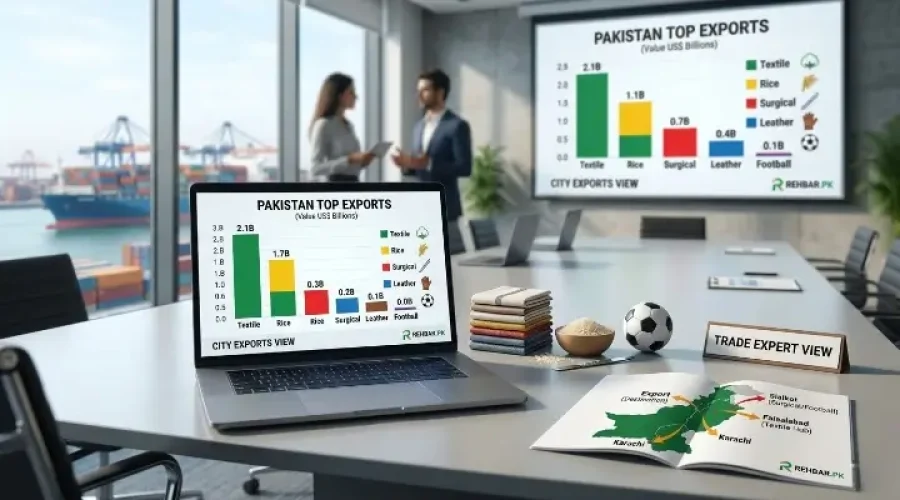
Exports from Pakistan depend on a narrow industrial base. A few cities drive most of the foreign exchange. Textiles dominate, while agriculture and light engineering fill the rest. Annual exports stay near 32 billion USD. The goal is clear. Move from raw and semi processed goods to high value products.
This guide breaks down city wise exports, production systems, target markets, revenue share, constraints, and clear actions to raise export earnings.
Pakistan Export Structure, Simple Breakdown
Pakistan relies heavily on limited industries.
• Textiles and garments, around 55 to 60 percent
• Rice, around 8 to 10 percent
• Leather, sports goods, surgical items, combined 10 to 15 percent
• Others including fruits, minerals, and small industries
This shows one clear point. Pakistan depends too much on textiles.
Karachi Exports, Textile and Garment Powerhouse
Karachi is the backbone of Pakistan’s exports. It has ports, factories, and large-scale industries.
Main exports from Karachi
• Readymade garments
• Knitwear
• Denim
• Leather jackets and bags
How these products are produced
Cotton comes from farms in Punjab and Sindh. Factories in Karachi turn cotton into yarn. Yarn is used to make fabric. Fabric is cut and stitched into garments.
Leather products follow a separate process. Animal skin is cleaned, treated with chemicals, and converted into finished leather goods.
Export markets
• United States
• European Union
• United Kingdom
These regions buy large volumes of clothing due to demand and trade agreements.
Read More: How to Register Company in Pakistan SECP Guide
Revenue and share
Pakistan earns over 16 billion USD from textiles. Karachi contributes a major portion of this.
Challenges
• High electricity and gas costs
• Delays in export shipments
• Strict EU compliance rules
How to increase exports
• Shift from basic garments to branded clothing
• Invest in modern machines
• Improve quality control
Faisalabad Exports, Textile Manufacturing Hub
Faisalabad is known as the Manchester of Pakistan.
Main exports
• Yarn
• Fabric
• Bedsheets and towels
Production process
Cotton is converted into yarn in spinning mills. Yarn is woven into fabric. Fabric is dyed and stitched into finished goods.
Export markets
• China imports yarn
• Europe imports finished textile products
Read More: How to Start Online Business in Pakistan?
Revenue
Home textile exports from Faisalabad generate around 5 billion USD.
Share
Faisalabad holds a major share within Pakistan’s textile exports.
Challenges
• Old machinery reduces efficiency
• Competition from Bangladesh and India
Growth strategy
• Upgrade textile machines
• Focus on design and branding
• Target high value markets
Sialkot Exports, Sports and Surgical Excellence
Sialkot has a unique export profile.
Main exports
• Footballs
• Sports equipment
• Surgical instruments
Production process
Football manufacturing involves cutting leather panels and stitching them manually. Surgical instruments are made from steel and shaped with precision tools.
Read More: How to Register NTN in Pakistan [Complete Guide]
Export markets
• Germany
• United States
• United Kingdom
Revenue
Sialkot exports generate around 2 billion USD annually.
Share
Around 6 to 8 percent of Pakistan’s total exports.
Challenges
• Heavy reliance on manual labor
• Strict medical certification requirements
Growth strategy
• Introduce automation
• Invest in international certifications
• Expand into new product categories
Multan Exports, Mango and Agriculture Strength
Multan is famous for mango exports.
Main export
• Mangoes
Production process
Mangoes are grown, harvested, sorted, and packed. They require cold storage to maintain freshness.
Export markets
• Middle East
• United Kingdom
• China
Revenue
Pakistan earns around 100 million USD from mango exports.
Share
Less than 1 percent of total exports.
Challenges
• Lack of cold storage
• Poor packaging
• Transport delays
Growth strategy
• Improve storage systems
• Develop branded mango exports
• Expand global reach
Read More: 8 Best Skills to Learn Online in Pakistan
Hyderabad Exports, Cultural Products
Hyderabad exports traditional handicrafts.
Main exports
• Ajrak
• Sindhi caps
Production
Handmade using traditional block printing and stitching.
Markets
• Middle East
• Europe
Challenges
• Small production scale
• Limited international marketing
Growth strategy
• Promote through e commerce
• Improve branding and packaging
Gujranwala Exports, Industrial Goods
Gujranwala focuses on manufacturing.
Main exports
• Cutlery
• Ceramics
Production
Metal shaping, polishing, and finishing. Ceramics are made using clay and high temperature kilns.
Markets
• Middle East
• Africa
Challenges
• Low product quality
• Limited innovation
Growth strategy
• Improve finishing standards
• Introduce new designs
Read More: How to Start Shopify Dropshipping in Pakistan
Quetta Exports, Fruits and Minerals
Quetta contributes through natural resources.
Main exports
• Apples
• Grapes
• Minerals
Challenges
• Poor road infrastructure
• Lack of storage
Growth strategy
• Improve logistics
• Invest in storage facilities
Data Table, City Wise Export Snapshot
| City | Main Export | Production Stage | Key Markets | Annual Revenue | Share in Pakistan Exports |
| Karachi | Garments, Leather | Spinning to stitching, tanning | US, EU, UK | 16B plus | 55 to 60 percent sector share |
| Faisalabad | Yarn, Home Textiles | Spinning, weaving, processing | China, Turkey, EU | 5B plus | Major textile share |
| Sialkot | Sports, Surgical | Stitching, machining, finishing | Germany, US, UK | 2B plus | 6 to 8 percent |
| Multan | Mangoes | Farming, grading, cold chain | Middle East, UK, China | 100M plus | Under 1 percent |
| Hyderabad | Handicrafts | Block printing, stitching | Middle East, EU | Small | Under 1 percent |
| Gujranwala | Metal, Ceramics | Casting, finishing | Middle East, Africa | Moderate | 2 to 3 percent |
| Quetta | Fruits, Minerals | Farming, extraction | Afghanistan, Gulf | Limited | Under 2 percent |
Infographic Style Summary
Pakistan’s export economy depends on textiles.
Karachi leads exports overall.
Faisalabad leads textile production.
Sialkot leads specialized goods.
Agriculture exports are growing but still small.
Major Export Challenges in Pakistan
• High production cost
• Low product diversity
• Weak branding
• Infrastructure issues
How Pakistan Can Increase Exports
• Move from raw materials to finished goods
• Invest in technology
• Improve global branding
• Support exporters with policies
If firms understand buyer requirements and cut lead time while improving quality, Pakistan can lift exports beyond 40 billion USD in the medium term.