How to Earn from YouTube in Pakistan
Thousands of Pakistanis are earning real money from YouTube right now. Some are pulling in PKR 30,000 a month from a small channel they run on weekends. Others are earning millions. Ducky Bhai (Saad ur Rehman) from Lahore, a roaster and streamer, has made an estimated $26.75 million since 2017 with 891,000 average daily views. That’s not luck. That’s strategy, consistency, and knowing how the money actually works.
This guide on how to earn from YouTube in Pakistan covers everything honestly: what you need to qualify, what you’ll actually earn, which niches pay the most, and how to build income beyond ads so you’re not dependent on CPM rates that are, frankly, quite low for Pakistani audiences.
What You Need Before YouTube Pays You
YouTube doesn’t pay everyone who uploads videos. You need to get accepted into the YouTube Partner Program (YPP) first, and that requires meeting specific thresholds.
To unlock ad revenue, you’ll need at least 1,000 subscribers and either 4,000 watch hours in the past 12 months or 10 million Shorts views in the past 90 days. You’ll also need one active Google AdSense account linked to your YouTube channel, and your channel must be in good standing with YouTube, following all monetization policies.
There is also an early-access tier that unlocks some earning features at 500 subscribers, though full ad revenue requires the 1,000 subscriber threshold.
AdSense calculates your finalized YouTube earnings for the previous month and adds them to your balance between the 7th and 12th of the current month. If your balance is over the $100 threshold and you have no holds, payments typically start processing around the 21st to 26th of that month. Wire transfers to Pakistani banks can take a few additional days depending on your bank.
In Pakistan, you get paid in US dollars, which can be withdrawn through Western Union or bank transfer via Google AdSense.
Read More: How to Start Freelancing in Pakistan
Step-by-Step: How to Get Monetized on YouTube from Pakistan
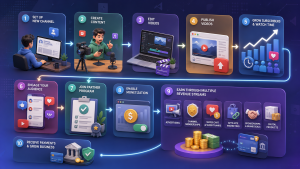
- Create your YouTube channel. Go to youtube.com and sign in with a Google account. Click your profile icon, then “Create a channel.” Choose a name that fits your niche and is easy to remember.
- Choose your niche and start uploading. Pick a topic you can cover consistently. Don’t upload randomly. A channel with 30 videos on one subject grows faster than one with 30 videos on 30 different topics.
- Reach 1,000 subscribers and 4,000 watch hours. This takes most channels three to twelve months of consistent uploading. Posting at least once a week, writing strong video titles, and sharing on social media speeds this up.
- Set up Google AdSense. Go to adsense.google.com and create an account using your real name and Pakistani address. Note that you can generally only have one AdSense account in your name.
- Apply for YPP. Go to YouTube Studio, click “Earn,” and click “Apply.” YouTube typically reviews applications within 30 days.
- Once approved, enable monetization on your videos. You can choose which videos carry ads and what ad types appear.
Read More: Best Freelancing Websites in Pakistan
How Much YouTube Actually Pays in Pakistan
This is where most articles dodge the truth. Let’s be direct.
Pakistan’s YouTube CPM stands at around $0.11 to $0.59 per 1,000 views. After YouTube’s standard 45% cut, the RPM (what you actually receive) for Pakistani creators is approximately $0.07 to $0.35 per 1,000 views, which translates to roughly Rs 19 to Rs 90 per 1,000 views.
The global median CPM is $2.91 per thousand ad viewsz, and the United States sits at $11.95. Pakistan is at the other end at $0.42.
That gap is significant, and it’s the reason Pakistani creators who rely only on AdSense from a domestic audience often feel frustrated by their earnings relative to their view counts. A channel with 500,000 monthly views primarily watched in Pakistan might earn PKR 10,000 to PKR 45,000 from ads alone. That’s a side income, not a full-time living, at that scale.
The good news is that this isn’t the whole picture.
Read More: How to Start Amazon Business from Pakistan
The Secret Most Pakistani Creators Eventually Discover
Your AdSense rate is based on where your viewers are, not where you are as a creator.
A creator sitting in Lahore making English-language finance content with a 75% US audience earns the same RPM as a US-based creator with the same audience mix. Your passport does not affect your AdSense rate. Pakistani creators successfully earning $6 to $12 RPM in 2026 share these characteristics: English-language content, topics with universal appeal such as finance basics, tech reviews, career advice, and business strategy, and SEO optimised for Google US/UK search.
That’s a massive insight. If you’re a Pakistani creator who speaks decent English and covers topics that US or UK audiences search for, your CPM is no longer limited by your local market.
In Pakistan, some niches like finance, tech reviews, and digital marketing have higher CPM rates, sometimes over $2.00, which is three to four times the local average. Finance content targeting international audiences can go much higher.
Read More: How to Start Shopify Dropshipping in Pakistan
Highest-Paying Niches for Pakistani YouTubers
| Niche | Pakistani CPM (local audience) | Potential CPM (international audience) | Difficulty |
| Finance/investing | $0.50 to $2+ | $15 to $36 | High |
| Tech reviews | $0.50 to $1.50 | $5 to $15 | Medium |
| Education/tutorials | $0.50 to $2.50 | $4 to $10 | Medium |
| Gaming | $0.20 to $0.50 | $2 to $5 | Medium |
| Cooking/food | $0.20 to $0.80 | $1 to $3 | Low |
| Family/lifestyle vlogging | $0.20 to $0.60 | $1 to $3 | Low |
CPM figures are estimates based on reported creator data and industry benchmarks. Actual rates vary by season, audience engagement, and advertiser demand.
Finance consistently tops the CPM table. Entertainment, lifestyle, and music sit at the bottom despite often generating higher raw view counts. This doesn’t mean you should fake interest in finance content, but if you have genuine knowledge in a high-CPM area, your ad earnings will reflect that.
Read More: How to Become a Freelancer Without Experience
Beyond AdSense: How Pakistani YouTubers Build Real Income
Relying only on ads is a mistake. The most successful Pakistani creators earn the majority of their income from sources other than AdSense.
Brand Sponsorships
Pakistani creators earn PKR 10,000 to PKR 50,000 per brand collaboration, while top creators can command PKR 3 million or more per deal.
Pakistani creators with 10,000 to 50,000 subscribers typically charge PKR 50,000 to PKR 200,000 per sponsored video. Channels exceeding 500,000 subscribers command PKR 500,000 to PKR 2,000,000 per integration.
Brands in Pakistan that commonly work with YouTubers include mobile phone companies (Samsung, Xiaomi, Tecno), food delivery apps, online stores, clothing brands, and software products. International SaaS companies like VPN providers and productivity tools also frequently sponsor English-language content creators, regardless of where the creator is based.
YouTube marketing expert Brendan Gahan recommends establishing your baseline flat fee by looking at the number of views your videos typically get, then multiplying by 5 cents to 15 cents per view. On a 50,000-view average, that puts a fair baseline between $2,500 and $7,500 per sponsored video.
YouTube Studio has a built-in feature called BrandConnect that matches eligible channels with potential brand partners using audience data.
Read More: 8 Best Skills to Learn Online in Pakistan
Affiliate Marketing
Affiliate marketing means you include trackable links in your video descriptions, and you earn a commission whenever someone buys through your link. Commission rates typically range between 10 and 20% but can exceed 30% for exclusive partnerships or high-ticket products. Technology, finance, and educational content creators particularly benefit from affiliate marketing.
Daraz.pk has an affiliate program. Amazon Associates works for English-language channels with international traffic. Digital products like web hosting (Hostinger, Bluehost) and software tools (Canva, TubeBuddy) pay commissions on recurring subscriptions, which builds passive income over time.

Channel Memberships and Super Chat
Once you’re in YPP and meet the eligibility criteria, you can offer channel memberships where viewers pay a monthly fee for exclusive badges, emojis, or bonus content. Super Chat lets viewers pay to have their comments highlighted during live streams.
Both work best for channels with engaged, loyal audiences rather than channels that just accumulate passive views.
Read More: How to Monetize YouTube Channel in Pakistan
Selling Your Own Products or Services
Many Pakistani creators eventually launch something of their own, whether that’s an online course, a consulting service, a digital product, or merchandise. Selling products or consulting services based on channel expertise can generate income even before YPP approval. It’s also the income stream that scales the best because there’s no platform taking a 45% cut.
Real Examples: How Pakistani YouTubers Are Earning
The cooking channel of Amna Riaz boasts over 4.4 million subscribers, and she is the first Pakistani woman to receive the Gold Play Button from YouTube. She has an estimated net worth of approximately $4.5 million, earned through cooking tutorials, brand deals, and sponsored posts targeting homemakers and food lovers.
The Sistrology channel, run by sisters Iqra and Fatima Faisal, attracts massive followings through lifestyle content and generates an estimated PKR 18 to 30 million monthly revenue from advertisements, sponsorships, and affiliate marketing.
Pakistani creators in niches like cooking, tech, education, and Islamic content earn between PKR 30,000 and PKR 5,00,000 per month. That range is wide because the factors that drive earnings vary enormously: niche, audience location, sponsorship activity, and consistency.
Read More: How to Monetize Facebook Page in Pakistan
Growing Your Channel: What Actually Works
The tactics that grow channels are well-documented, but they need to be applied consistently to matter.
Consistency over virality. A channel that uploads once a week for two years will almost always outperform one that posts twelve videos in a month and then disappears for six months.
Titles and thumbnails decide whether people click. YouTube is a search engine and a recommendation algorithm. Your video title needs to describe what’s in the video clearly. Your thumbnail needs to make someone stop scrolling. Both can be improved by studying what already works in your niche.
Watch time is the metric that feeds growth. A finance video posted in November, watched mostly in the US, with 10 or more minutes of viewer retention, could earn three to five times more than the same video in July with low-retention traffic from lower-CPM countries. YouTube’s algorithm rewards videos that keep people watching, not just videos that get clicked.
Cross-platform promotion matters early on. Share your videos on Facebook, Instagram, WhatsApp, and TikTok. The algorithm rewards external traffic. Pakistan’s Facebook user base is enormous and often feeds early YouTube subscribers to new channels in Urdu or regional language niches.
YouTube Shorts for subscriber growth. YouTube Shorts is driving explosive subscriber growth for new channels in 2026. Shorts don’t pay well per view, but they bring subscribers who then watch your long-form content, which does pay well. Use Shorts as a funnel, not an income source.
Read More: How to Earn from TikTok in Pakistan
What Your Channel Needs to Avoid
Getting rejected from YPP or getting demonetised after approval wastes months of work. Common reasons Pakistani channels get rejected or lose monetisation:
Reused content. Downloading videos from other platforms and reuploading them, even with commentary, often leads to rejection. YouTube’s system flags this clearly.
Copyright issues. Using popular songs without licences, even as background music, can get your videos claimed by rights holders who then take your ad revenue.
Misleading thumbnails or titles. Clickbait that doesn’t match the actual video content violates YouTube’s advertiser-friendly content policies.
Low effort or auto-generated content. Common rejection reasons include reused content, copyright issues, policy violations, and low-quality videos. YouTube specifically flags channels that look machine-generated or scraped.
Read More: How to Earn Dollars Online in Pakistan
FAQ
How much does YouTube pay per 1,000 views in Pakistan?
RPM for Pakistani creators is approximately $0.07 to $0.35 per 1,000 views when the audience is primarily Pakistani, translating to roughly Rs 19 to Rs 90 per 1,000 views. Creators targeting international audiences earn significantly more.
Can Shorts videos earn money in Pakistan?
Yes, but Shorts RPM remains lower at $0.03 to $0.07 per 1,000 views. Shorts are better used for building subscribers who then watch long-form content, rather than as a standalone income source.
Do I need a specific bank account to receive YouTube payments?
You need a Google AdSense account linked to your channel. In Pakistan, AdSense payments can be received through Western Union or direct bank transfer. Most Pakistani banks accept international wire transfers without issue.
Can I earn from YouTube before reaching 1,000 subscribers?
Sponsorships, affiliate marketing, and selling products can generate income even before YPP approval. Several Pakistani creators land brand deals once they reach a few thousand engaged subscribers, well before the AdSense threshold.
What is the minimum payout from YouTube AdSense?
Your AdSense balance must reach $100 before YouTube processes a payment. For small channels with mainly Pakistani viewers, this can take several months.
How long does it take to start earning?
There’s no fixed timeline. It depends on your niche, how consistently you upload, and how well your content performs in search. Most Pakistani channels that post consistently in a focused niche reach YPP requirements within six to twelve months.
The path to earning from YouTube in Pakistan is real and well-travelled. The AdSense CPM for Pakistani viewers is low, and that’s a fact worth accepting early rather than discovering after months of work. The creators who build sustainable income here treat ad revenue as one piece of a larger picture: brand deals, affiliate commissions, and their own products carry the weight. Pick a niche you can stay committed to, understand how the money works before you start, and spend as much time on your titles and thumbnails as you do on the content itself.
Read More: How to Make Money Without Investment