

How to Lose Weight Naturally: What the Research Says
Disclaimer: This article is for informational purposes only and does not constitute medical advice. If you have an underlying health condition, are significantly overweight, or plan to make major dietary changes, please consult a qualified doctor or registered dietitian first.
Everyone has a cousin, a coworker, or an Instagram account that claims to have the secret to weight loss. Cut carbs. Drink green tea. Try this tea. Fast for 16 hours. Take this pill.
Most of it is noise. The science of losing weight naturally is actually well-established, and it doesn’t require any supplements, extreme fasting protocols, or expensive programs. It does require understanding a few core principles, because without those, even good habits don’t add up to much.
This guide covers those principles, with the research behind them, and the practical steps that flow from it.
The Foundation: Calorie Balance Is Not a Myth
No credible researcher disputes the central role of energy balance in weight loss. According to the Mayo Clinic, cutting approximately 500 calories a day from your usual diet may result in about half a pound to one pound of weight loss per week, though this varies based on your body, gender, starting weight, and activity level.
That said, “eat less” is not the whole story. What you eat affects how hungry you feel, how efficiently your body uses energy, and how much muscle you preserve during weight loss. Two people running the same calorie deficit can have very different outcomes depending on what fills those calories.
Clinicians at Johns Hopkins recommend a calorie deficit of 500 to 750 calories per day for sustainable weight loss, with calorie goals of 1,200 to 1,500 for most women and 1,500 to 1,800 for most men, combined with exercise as an adjunct rather than the primary strategy.
The takeaway: exercise matters for health and for keeping weight off long-term, but diet is the larger lever for actual fat loss. You cannot outrun a poor diet, not practically.
Read More: How to Control Diabetes Naturally : 10 Proven Methods
Eat More Protein
This is probably the most well-supported nutritional change you can make for natural weight loss, and it’s one most people underdo.
Multiple meta-analyses of randomized controlled trials have found greater weight loss, fat mass loss, and preservation of lean mass after higher-protein energy-restriction diets compared to lower-protein diets. Reductions in triglycerides, blood pressure, and waist circumference were also reported.
Protein works for weight loss through several mechanisms. It keeps you full longer. It has a higher thermic effect, meaning your body burns more calories digesting protein than it does digesting fat or carbohydrates. It also protects your muscle mass during weight loss, which matters because muscle drives your resting metabolism.
A 2024 network meta-analysis of 78 randomized controlled trials confirmed that protein intake exceeding the standard recommended amount is protective for maintaining weight loss. Higher protein intake significantly reduced lean mass loss during energy restriction, particularly when combined with resistance training.
In practical terms: build your meals around a protein source first. Eggs, yogurt, lentils, chicken, fish, paneer, and legumes are all effective. A useful target for people actively trying to lose weight is around 1.2 to 1.6 grams of protein per kilogram of body weight per day, though exact needs vary. Getting there naturally reduces hunger and makes calorie control easier without relying on willpower alone.
Cut Ultra-Processed Foods, Not Just Calories
This distinction is important enough to deserve its own section.
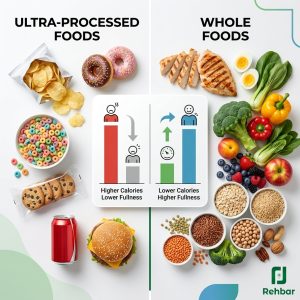
A landmark randomized controlled trial by researchers at the National Institutes of Health found that participants on an ultra-processed diet ate an average of 508 calories more per day and gained an average of 2 pounds over two weeks, compared to participants on an unprocessed whole-food diet who lost about 2 pounds on average over the same period, even though both diets were matched for total calories, macronutrients, fiber, sugars, and sodium.
That’s an extraordinary finding. It suggests the processed nature of the food itself, independent of its calorie content, affects how much you eat and how your body handles it.
Ultra-processed foods are calorie-dense, approximately 378 calories per 100 grams compared to around 68 calories per 100 grams for whole foods like fruits and vegetables. A 2024 umbrella review of 45 meta-analyses covering nearly 10 million people linked high ultra-processed food consumption to 32 health conditions including obesity and type 2 diabetes.
Ultra-processed food in this context means products made with industrial ingredients not used in home cooking: emulsifiers, artificial flavors, synthetic preservatives, and similar additives. This covers much of what lines supermarket shelves: packaged biscuits, most breakfast cereals, instant noodles, flavored chips, processed meats, many fruit juices, and carbonated soft drinks.
Switching even a portion of your daily eating to minimally processed whole foods, without counting a single calorie, tends to naturally lower your energy intake. The practical shift: cook from ingredients rather than packets wherever you can. Eat daal, sabzi, roti made at home. Add fruit and vegetables, eggs, and plain yogurt. The fewer ingredients on a label, the better.
Read More: Is Detox Water a Myth or Does It Really Work?

Fix Your Sleep Before You Fix Your Diet
Sleep is not a peripheral wellness topic. It directly affects your hunger hormones and metabolic function, and most people trying to lose weight completely ignore it.
Sleep deprivation leads to increased ghrelin, the hunger hormone, and decreased leptin, the appetite-suppressing hormone, resulting in an overall experience of constantly feeling hungry. Sustained high cortisol levels from poor sleep promote the accumulation of belly fat and can lead to prediabetes and other metabolic disorders.
A 2024 systematic review and meta-analysis found that short sleep duration is associated with higher risk of central obesity, partly through hyperactivation of the hypothalamic-pituitary-adrenal axis which increases cortisol levels, and through leptin reduction which drives hunger toward calorie-rich foods.
The practical implication: if you’re eating carefully but sleeping 5 to 6 hours a night, you’re fighting against your own biology. Hunger becomes harder to manage, cravings for high-calorie foods increase, and your ability to make food decisions under fatigue deteriorates.
Most adults need 7 to 9 hours of sleep. Getting to bed at a consistent time each night is more effective than trying to “catch up” on weekends. Reducing screen exposure in the hour before sleep and keeping your bedroom cool and dark are the most evidence-supported environmental changes for sleep quality.
Move More Throughout the Day, Not Just at the Gym
Exercise is genuinely important for health, cardiovascular fitness, mood, and long-term weight maintenance. Its role in acute fat loss, though, is more limited than most people expect.
Recent research demonstrates that physical activity is often less effective than dietary restriction for achieving initial weight loss, but it remains essential for long-term weight maintenance.
Where exercise makes a bigger difference is in non-exercise activity thermogenesis (NEAT): the calories you burn through movement that isn’t formal exercise. Walking to work, taking stairs, cooking, doing housework, standing rather than sitting. Recent reviews emphasize the role of non-exercise activity thermogenesis and non-exercise physical activity in total daily energy expenditure.
A person who walks 8,000 steps a day while working from home burns meaningfully more calories than one who walks 2,000 steps and goes to the gym for 45 minutes. Both matter, but total daily movement matters too.
MD Anderson’s dietitians recommend 150 to 300 minutes of moderate physical activity weekly for people in a calorie deficit, noting that this approach, combined with whole-food eating, allows most people to stay in a calorie deficit until they reach their goal weight.
If you currently do almost no exercise, a 30-minute daily walk is the single highest-return addition you can make. It’s free, low-injury risk, and contributes meaningfully to both NEAT and cardiovascular health. Build from there.
Read More: Government Hospitals in Lahore [Complete List]
Drink Water, and Understand What It Does
Water doesn’t burn fat. But adequate hydration does support satiety, and thirst is regularly mistaken for hunger, particularly in people who don’t drink water consistently.
Drinking water before meals has modest but real evidence behind it. A 2016 randomized controlled trial published in Obesity found that adults who drank 500ml of water 30 minutes before each main meal lost 1.3kg more over 12 weeks than those who didn’t. That’s not dramatic, but it costs nothing.
The more important point is what you’re replacing. Switching from regular soft drinks (which can add 150 to 300 calories per serving without any satiety benefit) to water or plain chai is a meaningful change most people in Pakistan can make immediately. Sugary drinks are one of the clearest contributors to excess calorie intake precisely because they don’t trigger the same fullness signals that solid food does.
Manage Stress Actively
Stress directly undermines weight loss through cortisol. Chronic stress keeps cortisol elevated, which promotes fat storage, particularly around the abdomen, and drives cravings for calorie-dense foods.
This isn’t a soft claim. Sustained high levels of cortisol increase insulin in the blood, promote belly fat accumulation, and can trigger a cyclical pattern of increased food cravings and further sleep disruption.
Stress management techniques with the best research support for weight-related outcomes include:
Regular physical activity: Exercise reduces cortisol and is one of the most consistent interventions for both stress and weight.
Sleep prioritization: Covered above, but sleep and stress are bidirectionally linked. Poor sleep worsens stress reactivity; high stress impairs sleep.
Reducing caffeine after midday: High caffeine intake in the afternoon and evening raises cortisol and disrupts sleep quality, creating a negative cycle for people trying to lose weight.
Brief mindfulness or breathing practices: Even 10 minutes of slow breathing or structured relaxation practice daily has demonstrated effects on cortisol reduction in short-term studies.
Read More: Government Hospitals in Islamabad Rawalpindi [Complete List]
Build Habits, Not Willpower
A 2024 systematic review reported that median habit formation takes 59 to 66 days, with implementation intentions (if-then planning) significantly improving habit automaticity during early behavior change phases.
This is why “just eat less and move more” advice, without structural support, fails most people. Willpower is finite and unreliable. Habits are automatic.
If-then planning means attaching a new behavior to an existing one. “If I make my morning chai, then I will eat a handful of nuts and an egg with it.” “If it’s 7pm, then I will take a 20-minute walk.” The specific trigger matters because it removes the decision from the process.
Tracking your food, even loosely, also helps. Not because counting calories is a permanent life strategy, but because most people have poor intuitive awareness of how much they’re eating. Apps like Cronometer or MyFitnessPal let you log meals with Pakistani food options. Two to four weeks of tracking builds a mental map of portion sizes and calorie density that stays with you afterward.
Frequently Asked Questions
How much weight can you lose naturally per week?
Safe, sustainable natural weight loss is generally 0.5 to 1 kilogram per week. Faster loss is possible early in the process (partly due to water weight), but attempting to lose more than 1 to 1.5kg per week through diet alone typically requires a deficit too large to maintain and risks lean muscle loss.
Do any natural supplements help with weight loss?
The evidence for most supplements is poor. Green tea extract and caffeine have modest, short-term effects on metabolism. Apple cider vinegar has some evidence for blunting post-meal blood sugar spikes, but its weight loss effects are minimal. No supplement replaces a calorie deficit from food and activity changes.
Is intermittent fasting effective for natural weight loss?
Intermittent fasting works primarily by reducing calorie intake in most people. The most studied approach is time-restricted eating (eating within an 8-hour window). Research shows it produces similar weight loss to continuous calorie restriction. Some people find it easier to maintain because it replaces complex calorie counting with a simple timing rule. Others find it makes them overeat in their eating window. It’s a tool, not a magic mechanism.
Does drinking green tea help lose weight?
Green tea contains catechins and caffeine, both of which have a small thermogenic effect. Studies suggest it may increase calorie burn by 3 to 4% in the short term, which amounts to 60 to 80 extra calories a day for most people. That’s meaningful over time but not transformative on its own. Green tea is worth drinking for broader health reasons, but it’s not a weight loss strategy by itself.
How long does it take to see results from natural weight loss changes?
Most people see measurable weight change within 2 to 3 weeks of consistent calorie deficit. Noticeable changes in how clothes fit tend to appear between 4 and 8 weeks. The body also redistributes over time in ways that don’t always show immediately on the scale. Progress photos and waist measurements are often more motivating than the scale alone.
The methods that actually work for natural weight loss aren’t complicated. A moderate calorie deficit, higher protein intake, minimally processed whole foods, adequate sleep, daily movement, and stress management. Each of these has strong research support. None require supplements, extreme restriction, or expensive programs.
The challenge isn’t knowing what to do. It’s building the habits that make doing it automatic. Start with one change this week, not all of them at once. Add protein to your breakfast. Switch one soft drink for water. Walk for 20 minutes after dinner. Habits build on habits, and six months from now, the cumulative effect is real.