
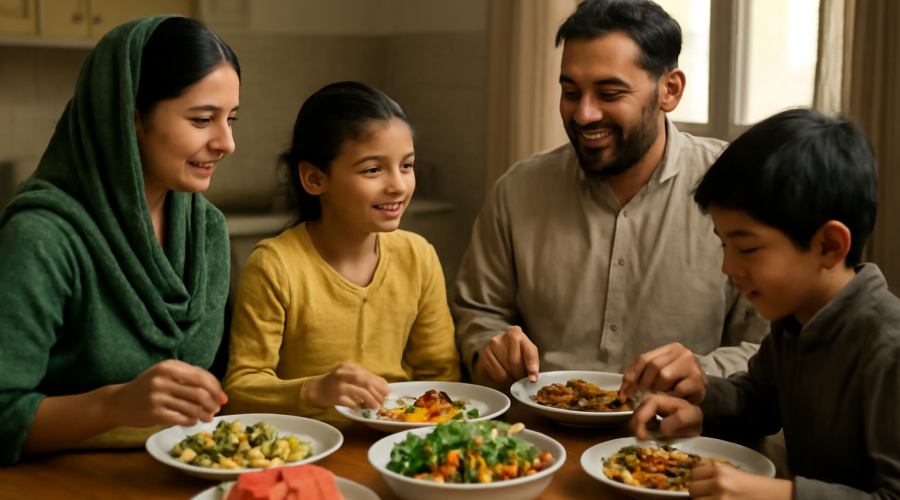
Healthy Eating Habits for Pakistani Families: A Real Guide
Disclaimer: This article is for general information only and isn’t a substitute for advice from a doctor, dietitian, or your child’s pediatrician. If you’re dealing with a diagnosed condition like diabetes, anemia, or a child’s growth concern, talk to a qualified health professional before changing your diet.
Open any Pakistani kitchen on a weeknight and you’ll usually find rice or roti, a meat or daal curry cooked in oil, maybe a vegetable nobody finishes, and a stack of leftover samosas from someone’s birthday two days ago. That’s not a failure of willpower. It’s just what eating looks like in a country where food culture, family obligations, and tight budgets all pull in different directions.
Building healthy eating habits for Pakistani families isn’t about switching to quinoa bowls or giving up biryani. It’s about making small, sustainable changes to a diet that’s already full of good ingredients, daal, vegetables, yogurt, whole spices, while fixing the parts that are quietly causing harm: too much refined oil, too much sugar, not enough variety, and portions that have crept up over the years.
The numbers explain why this matters. Pakistan now has the highest global ranking for type 2 diabetes prevalence among adults aged 20 to 79, and diabetes cases are projected to rise from 34.5 million in 2024 to 70.2 million by 2050 if nothing changes. At the same time, more than 40% of Pakistani children under five are stunted, meaning their bodies haven’t grown the way they should because of poor diet quality. Two crises, overweight adults and undernourished kids, often sitting at the same dinner table. This guide walks through what’s actually going on and what you can realistically do about it.
Why Pakistani Families Are Facing Two Opposite Nutrition Problems
Pakistan’s nutrition picture is unusual because it runs in both directions at once. In the same household, you might have a grandmother with type 2 diabetes, a mother with anemia, and a toddler who isn’t growing fast enough. This is sometimes called the “double burden of malnutrition,” and Pakistan is one of the clearest examples of it in South Asia.
On the undernutrition side, the data is sobering. The 2018 National Nutrition Survey and more recent UNICEF figures show nearly 10 million Pakistani children suffer from stunting, and only 38% of children are exclusively breastfed for their first six months of life, well below what’s recommended. More than half of children under five are deficient in vitamin A, 40% are deficient in both zinc and vitamin D, and close to 62% are anemic. Researchers point out that this isn’t only about not having enough food. It’s about both the quantity and quality of what children are eating.
Provincial gaps are wide too. According to Gallup Pakistan’s analysis of national survey data, Balochistan has the highest stunting rate at 46.6%, followed by Sindh at 45.5%, Khyber Pakhtunkhwa at 40%, and Punjab at 36.4%, broadly tracking each province’s relative prosperity.
On the other side of the table, adult metabolic disease is climbing fast. A Karachi-based study of otherwise healthy adults found metabolic syndrome, the cluster of high blood sugar, high blood pressure, excess belly fat, and abnormal cholesterol, present in roughly a third of the sample, depending on which diagnostic definition was used. Obesity rates are even starker: one widely cited estimate puts generalized obesity at nearly 58% and central (belly) obesity at over 73% of the adult population, using Asia-Pacific BMI cutoffs that are stricter than Western ones because South Asians tend to develop diabetes and heart disease at lower body weights.
What connects both ends of this problem is diet quality. Cheap, calorie-dense, nutrient-poor food, white flour, sugar, repeatedly heated oil, can simultaneously leave a child short on the vitamins they need to grow and set an adult up for insulin resistance. Fixing this at a family level doesn’t require two different diets. It requires the same shift: more whole foods, less processed sugar and oil, more variety, and feeding everyone, including pregnant and breastfeeding mothers, with enough quality protein and micronutrients.
What the Pakistan Dietary Guidelines Actually Recommend
You don’t need to invent a meal plan from scratch. Pakistan already has an official, government-backed framework: the Pakistan Dietary Guidelines for Better Nutrition (PDGN), developed by the Ministry of Planning, Development and Special Initiatives with the Food and Agriculture Organization (FAO). It’s built specifically to be simple to adopt, with age and gender appropriate, culturally acceptable food choices, rather than copying a Western food pyramid wholesale.
The guidelines were created because, as the report itself notes, about half of Pakistan’s population is deficient in one or more essential nutrients, a gap the authors link to unhealthy dietary practices compounded by poor hygiene and sanitation. They flag women and young children as the groups most vulnerable to nutritional deficiencies and related health risks.
A few practical takeaways from the broader nutrition science behind these kinds of guidelines, and from WHO’s global recommendations that Pakistani health bodies also reference:
Salt: WHO recommends adults keep sodium intake under 2 grams a day, which works out to about 5 grams of salt. That’s roughly one level teaspoon, for everything you eat in a day, including the salt already in pickles, papad, namkeen, and restaurant food. Most Pakistani households use far more than this without realizing it, since salt gets added at multiple stages of cooking.
Sugar: WHO’s guideline is to keep free sugars under 10% of total daily calories, with extra benefit from getting under 5%, which is roughly 25 grams or 6 teaspoons a day on a standard 2,000 calorie diet. This covers sugar in tea, soft drinks, mithai, and packaged snacks, not just the sugar bowl on the table. For a country where sweet tea is consumed multiple times a day in most homes, this single number is probably the most actionable one in this entire article.
Fruit and vegetables: WHO recommends 400 grams of fruit and vegetables a day, around five servings. Most Pakistani diets fall short here, not because produce isn’t available, but because vegetables often appear as a small side to a much larger portion of meat, rice, or roti.
Fixing the Cooking Oil and Ghee Problem Without Losing the Flavor
Cooking oil is probably the single biggest lever for change in a typical Pakistani kitchen, because it’s used in almost everything: the daal, the sabzi, the karahi, the paratha, the pakoray.
The honest advice here isn’t to eliminate oil or ghee. Fat is a normal part of a balanced diet, and ghee in particular carries cultural and culinary weight that isn’t going anywhere. The issue is volume and frequency. Nutrition guides note that for someone with a mostly sedentary lifestyle, limiting ghee to one to two teaspoons a day avoids unnecessary extra calories, which is a useful mental benchmark even if you’re cooking with a mix of oil and ghee rather than ghee alone.
A few changes that don’t require giving up the dishes you love:
- Measure instead of pouring freehand. Most home cooks pour oil straight from the bottle into the pan, which makes it easy to use two or three times what a recipe needs. Switching to a measuring spoon for the first week of a recipe, then eyeballing it afterward, usually cuts oil use noticeably.
- Don’t reuse oil for deep frying. Repeatedly heated oil breaks down into compounds linked to inflammation and heart disease. If you fry pakoray or samosas for Iftar or a family gathering, use fresh oil rather than topping up an old batch.
- Shift some dishes from frying to roasting or grilling. Tikka, seekh kebab, and roasted vegetables can be cooked with a fraction of the oil a karahi dish needs, while keeping the same spice profile.
- Skim visible fat off curries once they’ve cooked, rather than mixing it back in. A lot of the oil that rises to the top during cooking isn’t needed for flavor, it’s just there because it was added during the bhunai (frying) stage.
Building a Better Daily Plate: What to Add, Not Just What to Cut
A lot of nutrition advice focuses entirely on restriction, which is part of why it doesn’t stick. A more useful frame for Pakistani households is asking what’s missing from the plate, not just what needs to go.
Protein variety beyond red meat
Mutton and beef dominate special-occasion cooking, and chicken shows up constantly in everyday meals, but plant proteins are underused given how cheap and available they are. Daal (lentils), chickpeas (chana), kidney beans (rajma), and besan are inexpensive, shelf-stable, and packed with fiber and protein in a way that white rice and naan are not. A simple, low-cost shift is making daal the default lunch two or three times a week instead of a fallback when there’s no meat in the fridge.
Eggs deserve more credit too. They’re cheap relative to meat, cook in minutes, and are one of the few foods that delivers complete protein along with vitamin D and choline, both commonly low in Pakistani diets.
Whole grains instead of refined flour
Most roti in Pakistani homes is made from atta that’s already whole wheat, which is genuinely a nutritional advantage over white bread. The bigger gap is rice, naan from tandoors (often made with refined maida), and the sheer volume of fried snacks made from maida, like samosas and pakoray. Swapping naan for roti at home most days, and treating maida-based fried snacks as occasional rather than daily, makes a real difference without asking anyone to give up rice or roti altogether.
Dairy that isn’t sweetened
Yogurt (dahi) is already a staple in most Pakistani kitchens, which is a genuine strength, plain dahi is a good source of protein, calcium, and probiotics. The issue is what often gets added to it or replaces it: sweetened lassi, flavored milk drinks, and condensed-milk-based desserts. Keeping plain dahi as the daily default, and saving sweetened dairy for special occasions, keeps the benefit without the added sugar load.
Fruit as the default snack
Pakistan grows excellent, genuinely seasonal fruit, mangoes in summer, citrus and guava in winter, that’s both cheaper and more nutrient-dense than packaged snacks during its season. Keeping cut fruit visible and ready in the fridge, the way chips or biscuits usually are, makes it the easier choice rather than the one that requires effort.
Practical Habits for Specific Family Members
For pregnant and breastfeeding mothers
Maternal nutrition has a direct line to child outcomes in Pakistan. Research cited by child welfare organizations notes that around one in three mothers in Pakistan are malnourished, and about half of those mothers also have anemia. Since children of malnourished mothers face a higher risk of cognitive impairment, short stature, and weaker resistance to infection, this isn’t just about the mother’s own health, it shapes the next generation’s growth before a child has even had their first solid meal.
Iron-rich foods (red meat, daal, leafy greens like saag and palak), along with continuing to eat enough overall during pregnancy and breastfeeding rather than restricting, matter more here than any single supplement. If anemia is suspected, a simple blood test and consultation with a doctor is worth more than guessing.
For children, especially under five
The window from conception to a child’s second birthday, often called the first 1,000 days, is when nutrition has the biggest long-term impact on growth and brain development. UNICEF Pakistan is explicit that stunting isn’t only about whether a child is getting enough food. It’s about the diversity and quality of that food alongside other factors like clean water and sanitation.
In practice, this means a child eating roti and daal every day still might be missing key nutrients if that’s all they’re eating. Rotating in eggs, dairy, seasonal fruit, and vegetables, rather than relying on the same two or three dishes on repeat, closes more of that gap than any single “superfood” would.
For school-age kids and teenagers
This is usually where packaged snacks, sugary drinks, and fast food start replacing home-cooked meals, especially with pocket money and school canteens involved. You don’t need to ban these foods outright, that tends to backfire. A more workable approach is making sure the meals you do control, breakfast and dinner at home, are solid, so a canteen samosa or a soft drink at a friend’s house isn’t undoing an otherwise empty day of eating.
A Realistic Weekly Approach, Not a Diet Plan
This table isn’t a rulebook. It’s a way to see that the upgrade is usually one swap per meal, not a total overhaul. Families that try to change everything at once tend to abandon it within a few weeks. Families that change one habit at a time tend to keep it.
Common Questions Pakistani Families Ask
Is desi ghee healthier than cooking oil?
Neither is automatically “healthier” or “unhealthy.” Desi ghee is high in saturated fat, while most cooking oils used in Pakistan (like soybean or sunflower oil) are higher in unsaturated fats, generally considered better for heart health in larger amounts. The bigger factor for most families isn’t which fat they use, it’s how much of either one goes into the cooking, and that’s the part worth paying attention to.
How much salt is too much for a Pakistani household?
WHO’s benchmark is around 5 grams of salt a day for adults, roughly one teaspoon, counting everything eaten, not just what’s added at the table. Pickles, papad, namkeen, and restaurant food all add up quickly, so the salt shaker is often not the main source.
Why are so many Pakistani children stunted if there’s enough food in the house?
Stunting is driven by diet quality and diversity, not just calorie quantity. Nutrition researchers point to insufficient dietary diversity and inadequate calories as central issues in Pakistani children’s diets, alongside factors like infections, sanitation, and maternal health during pregnancy.
Is Pakistan really the country with the highest diabetes rate in the world?
By current estimates, yes, at least by age-standardized prevalence. Pakistan currently has the highest prevalence of diabetes among adults aged 20 to 79 of any country tracked by the International Diabetes Federation, and projections suggest the case count will keep climbing sharply through 2050 without major changes to diet and physical activity at a population level.
Do I need to cut out rice and roti to eat healthier?
No. Whole wheat roti and rice in reasonable portions aren’t the problem on their own. The bigger issues are usually portion size relative to vegetables and protein, the amount of oil used in cooking, and how often fried snacks and sugary drinks fill the gaps between meals.
Where to Start This Week
Pick one change from this article, not five. Measure your cooking oil for a week. Swap sweetened lassi for plain. Add a daal-based lunch twice this week instead of meat every day. Keep cut fruit in the fridge where the biscuits usually sit. The data on stunting and diabetes in Pakistan is genuinely serious, but it’s the result of small habits repeated daily for years, which means it can be undone the same way: small habits, repeated, starting with whichever one feels doable today.