
Yoga Poses for Back Pain and Posture: What the Research Actually Supports
Your back probably isn’t broken. It’s bored.
That sounds glib for something that affects an estimated 619 million people worldwide, according to the Global Burden of Disease Study published in The Lancet Rheumatology, with South Asia carrying the highest absolute number of cases of any region. But for most non specific low back pain, the kind without a clear structural cause like a fracture or herniated disc, the problem is usually a mix of disuse, stiffness, and hours spent in one shape. A desk chair. A motorbike seat. A phone tilted down toward your chin for the better part of a decade.
Yoga won’t fix everything. It isn’t a substitute for medical care if you have radiating pain down a leg, numbness, or pain following an injury. But for the everyday ache that comes from sitting too long and moving too little, there’s now genuinely solid research behind specific poses and sequences, not just wellness culture hand waving.
This guide walks through what the science says, which poses actually have evidence behind them, how to build a short daily routine, and where to be careful.
A quick disclaimer: this article is for general information and isn’t medical advice. If you have severe, persistent, or worsening back pain, numbness, weakness, or pain after a fall or accident, see a doctor or physiotherapist before starting any new exercise routine.
Why Your Back Hurts in the First Place
Office workers report neck pain at rates around 53.5%, lower back pain at 53.2%, and shoulder pain at 51.6%, according to occupational health survey data compiled by physical therapy researchers. A study in Healthcare (2024) on forward head posture found that people who sit at traditional desks for long stretches report measurably more neck and shoulder discomfort than those using sit stand setups.
The mechanism is fairly well understood. Slouched sitting increases posterior pelvic rotation and thoracic flexion, pulling your head forward of your shoulders. Researchers in a 2025 Frontiers in Pain Research study tracking office workers found that prolonged sitting and habitually holding the neck in a forward bent position were both independently linked to higher rates of neck pain, with odds ratios above 2 for each. Forward head posture alone has been associated with neck pain prevalence reaching almost 87% in some populations.
None of this means your spine is fragile. It means it’s adapted to a shape you didn’t choose on purpose, and it needs reminding what else it can do.
What the Research on Yoga and Back Pain Actually Shows
The evidence has gotten noticeably stronger in the last two years, not just more abundant.
A randomized controlled trial out of Cleveland Clinic, published in JAMA Network Open in November 2024 and led by Dr. Robert Saper, followed 140 employees with chronic low back pain. Half took 12 weeks of live, virtual hatha yoga classes; half sat on a waitlist. At the beginning of the study, participants reported their back pain levels as around 6 out of 10. After six weeks, the yoga students’ reported pain levels dropped to 4, and after six months, slid to 3, while the waitlist group’s pain stayed flat. At the start, 74% of participants were taking some form of pain medicine. Six months later, less than a third of the yoga group still needed medication, compared with more than half of the waitlist group. Saper, who chairs Wellness and Preventive Medicine at Cleveland Clinic, called the results a meaningful addition to the options doctors can offer patients who don’t respond well to standard care.
A separate 2024 study from researchers in Italy, published in the Journal of Orthopaedic Research, put women with chronic low back pain through an eight session yoga program delivered partly in person and partly via telehealth. Average pain dropped from 6.8 to 3.3 on a 10 point scale over four weeks, and a spinal movement marker called the flexion relaxation phenomenon, often disrupted in people with chronic back pain, improved significantly. Lead author Alessandro De Sire of the University of Catanzaro noted that longer term follow up is still needed, which is a fair caveat given the small sample size.
A widely cited pooled analysis of randomized controlled trials on yoga for chronic low back pain found the strongest, most consistent evidence for short term improvements in functional disability, with longer term benefits present but smaller and more variable across studies. The same review noted that one trial comparing yoga to simple stretching found no significant difference between the two, a useful reminder that yoga isn’t magic. Consistent movement of almost any kind seems to help; yoga is one well studied, accessible way to get that movement, especially because it pairs stretching with body awareness and breath control.
The 2021 Cochrane review on yoga for low back pain reached a similar, more cautious conclusion: yoga probably helps with pain and function in the short term compared to no exercise, but the evidence quality across many older trials was mixed, partly because it’s nearly impossible to blind a participant to the fact that they’re doing yoga.
Where this lands practically: yoga has real, replicated evidence behind it for chronic non specific low back pain, on par with or modestly better than general stretching and exercise programs, with added benefits for sleep and reduced reliance on pain medication.
The Poses With the Most Evidence Behind Them
These aren’t randomly chosen. Each one shows up repeatedly in the clinical literature and in physical therapy guidance for back pain and postural correction.
Cat Cow Pose (Marjaryasana Bitilasana)
This is the one nearly every back pain study and protocol includes in some form, and for good reason. It moves the spine through flexion and extension slowly, which helps restore mobility in stiff segments without loading the spine.
How to do it:
- Start on hands and knees, wrists under shoulders, knees under hips.
- Inhale, drop your belly, lift your chest and tailbone (Cow).
- Exhale, round your spine, tuck your chin and tailbone (Cat).
- Move slowly between the two for 6 to 10 breaths, letting the movement start at the pelvis and travel up.
If your wrists complain, drop down onto your forearms instead.
Child’s Pose (Balasana)
A passive stretch for the lower back and hips, and a genuine rest position between more active poses. It’s commonly used as both a warm up and a reset when a sequence gets too intense.
How to do it:
- Kneel, big toes touching, knees apart roughly hip width.
- Sit back toward your heels and fold forward, arms extended or resting alongside your body.
- Let your forehead rest on the mat or a block. Breathe for 30 to 60 seconds.
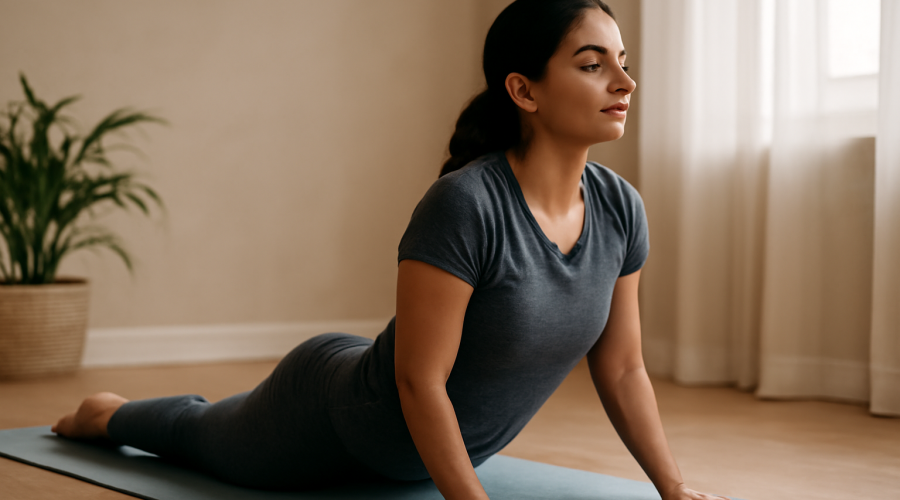
Cobra Pose (Bhujangasana)
Cobra strengthens the muscles along the spine and counters the slouched, forward leaning posture that builds up from sitting. Yoga therapists working with rounded shoulder posture often specifically recommend doing Cobra with the chin gently tucked, which targets the deep neck flexors and the muscles between the shoulder blades rather than just arching the neck back.
How to do it:
- Lie face down, palms under your shoulders, elbows hugging your ribs.
- Press the tops of your feet down, engage your legs and glutes lightly.
- Inhale and lift your chest, keeping a slight bend in your elbows, gaze forward or slightly down.
- Hold 15 to 30 seconds, lower with control.
Stop well short of your end range here. You want a stretch across the front of your torso, not a pinch in your lower back.
Downward Facing Dog (Adho Mukha Svanasana)
This stretches the hamstrings, calves and shoulders while lengthening the spine, and builds genuine strength through the arms and core. It also improves circulation through the upper body, which matters when most of your day is spent slumped forward.
How to do it:
- From hands and knees, tuck your toes and lift your hips up and back.
- Bend your knees as much as you need to so your spine stays long, rather than rounding to force your heels down.
- Press firmly through your hands, let your head hang relaxed.
- Hold for 5 to 8 breaths.
Sphinx Pose
A gentler alternative to Cobra that’s often better tolerated by people with more sensitive lower backs, since the forearms stay on the ground and the lift is less extreme.
How to do it:
- Lie face down, forearms on the mat, elbows under shoulders.
- Press your forearms down and lift your chest, keeping your lower ribs and hips grounded.
- Hold for 30 to 60 seconds, breathing normally.
Seated Forward Bend (Paschimottanasana)
A standard part of daily back focused sequences recommended in multiple yoga therapy guides for releasing tension along the back line of the body and improving hamstring flexibility, which indirectly reduces strain on the lower back during everyday bending.
How to do it:
- Sit with legs extended in front of you.
- Hinge from the hips, not the waist, reaching toward your feet.
- Keep a slight bend in the knees if your hamstrings are tight. Don’t force a flat back; let it round naturally.
- Hold 30 to 60 seconds.
Cow Face Pose (Gomukhasana), upper body variation
Mostly known as a hip opener, but the arm position in this pose is genuinely useful for thoracic and shoulder mobility, which ties directly into upper back posture.
How to do it:
- Sitting or standing, reach one arm up and bend the elbow, hand falling between your shoulder blades.
- Reach the other arm down and behind your back, bending the elbow up.
- Try to clasp your hands, or use a strap or towel if they don’t meet.
- Hold 20 to 30 seconds each side.
Supine Spinal Twist (Supta Matsyendrasana)
A gentle rotational stretch that’s frequently paired with Cat Cow and Cobra in posture focused sequences. Yoga therapists treating upper crossed posture patterns often use extended holds here, sometimes 16 breaths or more per side, specifically to lengthen tight chest muscles that pull the shoulders forward.
How to do it:
- Lie on your back, knees bent, feet flat.
- Drop both knees to one side, keeping shoulders flat on the mat.
- Turn your head the opposite direction if comfortable.
- Hold 30 to 60 seconds each side.
Warrior I (Virabhadrasana I)
A standing pose that opens the front of the hips and chest while building strength through the legs and back. Inhaling deeply during backbends like this one helps expand the ribs, which works against the chest collapsing posture common in people who sit a lot.
How to do it:
- Step one foot back, both feet pointing roughly forward, back heel grounded or lifted.
- Bend the front knee toward 90 degrees.
- Raise both arms overhead, lengthening through the spine rather than overarching the lower back.
- Hold 5 to 8 breaths, switch sides.
A 15 Minute Daily Routine
This sequence pulls from the poses above in an order that warms the spine up gradually, works through flexion and extension, and ends with relaxation. It’s close to what’s used in several of the structured yoga therapy programs referenced above.
Three to five sessions a week is a reasonable target based on the frequency used in the clinical trials above, most of which ran weekly classes with daily home practice encouraged in between.
Safety: What Researchers Actually Caution Against
Yoga is generally low risk, but it isn’t risk free, and the research is honest about that.
The U.S. National Institutes of Health describes yoga as generally safe for healthy people when performed properly under qualified instruction, while cautioning that injuries can occur, as with any physical activity. In the Cleveland Clinic JAMA Network Open trial, three participants in the yoga group reported temporary flare ups of back pain possibly related to their practice, out of 140 total participants. That’s a useful real number rather than a vague warning.
A few practical rules drawn directly from how the trial instructors coached participants:
- Discomfort during a stretch is normal. Sharp or shooting pain is not. Saper’s guidance to participants was direct: if you feel pain, come out of the pose or ask for a modification.
- Use props. The study’s instructors trained beginners to use blocks and chairs to adapt poses to their level, which is standard practice in therapeutic yoga settings, not a sign you’re doing it wrong.
- If you have a diagnosed disc issue, spinal stenosis, osteoporosis, or you’re pregnant, talk to a doctor or physiotherapist before starting, and look for a class or instructor with experience in therapeutic yoga rather than a general fitness class.
- Avoid pushing into deep backbends or forward folds in the first few weeks. Mobility improves gradually; forcing it tends to backfire.
How This Applies If You’re in Pakistan
Back pain isn’t a uniquely Western office problem. The 2025 working age burden analysis published in Frontiers in Public Health, using Global Burden of Disease data, found that South Asia reported the highest absolute number of low back pain cases of any world region, driven largely by population size and rising rates of sedentary work. Long commutes on two wheelers, desk jobs with non adjustable furniture, and floor seating that shifts suddenly to chair based office work in adulthood all show up as plausible contributing patterns in the broader literature on posture and back pain, even where Pakistan specific data is thinner than data from the US or Europe.
The practical takeaway doesn’t change much by geography. A few minutes of spinal movement daily, done consistently, shows up across the research as more protective than anything you do once a month for an hour.
Frequently Asked Questions
How long before yoga helps with back pain?
In the Cleveland Clinic trial, participants saw meaningful pain reduction by six weeks, with continued improvement through six months. Some people feel looser after a single session, but real change in chronic pain tends to take consistent practice over a month or more.
Can yoga fix bad posture permanently?
It can meaningfully improve postural habits and the strength and flexibility that support good posture, especially when combined with ergonomic changes like monitor height and chair support. It won’t override hours of slumped sitting if the rest of your day doesn’t change too.
Is yoga better than physiotherapy for back pain?
They’re not really competitors. Several of the trials referenced here were run by hospital systems specifically as an addition to standard care, not a replacement for it. If you have a specific diagnosis, physiotherapy guided by an assessment will likely get you further than a general yoga routine alone.
What if I can’t touch my toes or do a full backbend?
None of that matters for getting the benefit. Every study cited here used beginner adapted versions of these poses, often with props. Range of motion improves with practice; it isn’t a prerequisite to start.
Can I do these poses with a herniated disc?
Some of them, cautiously, and only with guidance from a doctor or physiotherapist who’s seen your specific situation. Forward folds and deep twists can aggravate certain disc issues. This is one case where general advice genuinely isn’t a substitute for a professional looking at your case.
If your back pain is the dull, familiar kind that shows up after a long day at a desk, a short daily practice built around these poses has real research behind it, not just tradition. Start with five poses, ten minutes, most days of the week, and pay attention to how your body responds rather than forcing a routine that doesn’t fit.