
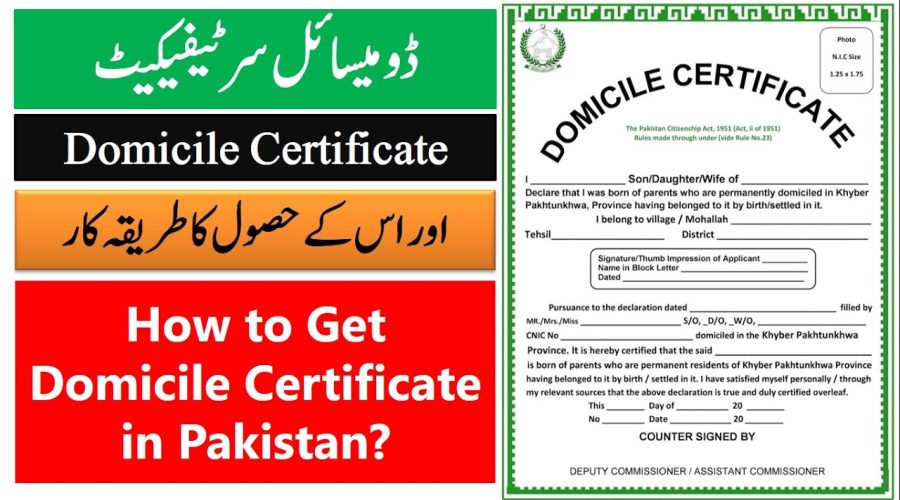
How to Apply for Domicile Certificate Online in Pakistan
Securing a government job, claiming a seat at a public university, or buying state-allocated land in Pakistan requires one foundational document: a domicile certificate. Issued under the Pakistan Citizenship Act 1951, this legal paper proves your permanent residency in a specific district.
Historically, getting your hands on this document meant enduring endless visits to the local Deputy Commissioner’s office, dealing with pushy agents, and waiting weeks for manual records to move. Thankfully, provincial governments have rolled out digital systems to clear the administrative backlog. The process looks completely different depending on your province, as some regions offer doorstep courier delivery while others use hybrid portals. This detailed guide breaks down how to apply for a domicile certificate online in Pakistan, covering required documents, fees, and exact provincial steps.
Core Documents You Must Gather First
Before downloading an app or opening a government website, you need to set up your digital document folder. Scanning everything beforehand keeps your application from getting rejected due to missing paperwork.
The baseline documents required across most districts include:
- Applicant CNIC or Form-B: If you are under 18 years of age, your NADRA Form-B is mandatory.
- Father or Guardian CNIC: A clear copy of your father’s national identity card.
- Proof of Permanent Residence: A recent utility bill (electricity, gas, or water), a registered house tenancy agreement, or land property ownership papers (Fard or Registry).
- Educational Certificates: Copies of your Matriculation, Intermediate, or higher degree mark sheets. The address on these certificates should ideally align with your target district.
- Passport-Size Photographs: Two to four recent passport-sized photos with a clean white or blue background.
- Affidavit of Non-Duality: A signed legal declaration on a stamp paper stating you do not hold a domicile certificate from any other district in Pakistan.
Read: How to Apply for Police Character Certificate Online in Pakistan
The Punjab Doorstep System: Maryam Ki Dastak
The Punjab Information Technology Board (PITB) manages the Domicile Management System, but they recently shifted public delivery to a specialized app called Maryam Ki Dastak (Dastak Citizen App). This service completely removes the need to visit government offices by sending a certified facilitator directly to your home.
Step-by-Step Dastak App Process
- Install the Dastak Citizen App:2 minutes.
Download the Dastak Citizen App from the Google Play Store or Apple App Store. Register your personal profile using your active mobile number and CNIC.
- Select the Domicile Service:3 minutes.
Navigate to the Board of Revenue services section on the home screen. Tap on “Domicile Certificate” to open the local service requirements window.
- Schedule a Facilitator Visit:2 minutes.
Enter your exact residential address and select a convenient date and time slot. The system will assign a trained, background-checked Dastak Facilitator to your case.
- Facilitator Processing at Home:15 minutes.
The facilitator arrives at your house on schedule. They will use their tablet to scan your physical documents (CNIC, photos, utility bills), capture your biometric verification, and process the application directly into the PITB database.
- Pay Fees via Gateway:5 minutes.
Pay the standard domicile fee plus a fixed service delivery charge. You can pay with cash on delivery or digitally using integrated mobile wallets like JazzCash, EasyPaisa, or an online banking PSID.
Once processed, the Assistant Commissioner reviews the digital file. The department prints the physical certificate and uses a courier partner to deliver it straight back to your doorstep within 5 to 7 working days.
Read: How to Check FRC NADRA Online
The Islamabad Hybrid Framework: Citizen Facilitation Center
For residents of the federal capital, the Islamabad Capital Territory (ICT) Administration runs a streamlined, dual-visit system managed through the Citizen Facilitation Center (CFC).
- The Eligibility Rule: To secure an Islamabad domicile, at least one address on your CNIC must state Islamabad, and the card issue date should be at least one year old (though first-time CNIC holders at age 18 are exempt from the one-year rule).
- Initial Submission: Go to the official portal at cfc-ict.com to review document rules and fill out the digital Form-P. Any authorized person can submit the initial physical file along with your utility bills and residence proof at the CFC counter to get a tracking receipt.
- The Second Visit: After 3 working days, check your application status on the portal. Once approved, the actual applicant must visit the CFC in person. You will pay a Domicile Fee of Rs 200 alongside a NADRA biometric fee of Rs 120, complete a live photo check, and walk out with your printed certificate.
The Khyber Pakhtunkhwa Citizen Portal System
The Performance Management and Reforms Unit (PMRU) of KP runs an interactive e-Domicile System across all Deputy Commissioner offices in the province.
You can complete the application workflow using the KP Citizen’s Portal mobile app or its corresponding web portal at cfc.kp.gov.pk.
- Register a profile on the KP Citizen’s Portal app using your phone number and identity credentials.
- Tap the “e-Citizen” tab and open the digital domicile request form.
- Fill out your permanent town, tehsil, and district details, then upload clean digital copies of your academic records and local utility bills.
- Submit the application to generate an automated transaction tracking ID.
- Monitor your application status on the app dashboard. If local administrative checks find errors, you will see a “deficiencies noted” alert. If everything looks good, the app sends a notification to collect your stamped certificate from the local DC office, or you can opt for home delivery if your district supports integrated postal service.
Read: How to Update Marital Status on CNIC
The Sindh Process: Deputy Commissioner Office Portal
Unlike the fully paperless apps running in northern provinces, the Government of Sindh operates a local hybrid system. According to provincial public service updates, you cannot acquire a domicile or Permanent Residence Certificate (PRC) entirely online without a physical verification check.
For example, the Deputy Commissioner South Karachi portal at commissionerkarachi.gos.pk/dcsouth-logins allows you to track cases and download structural templates, but you still need to follow a localized processing pattern.
| Processing Stage | Required Action in Sindh Districts |
| Step 1: File Preparation | Gather your family CNICs, Computerized Nikkah Nama, school certificates, and a certified voter list copy from the Election Commission confirming your name is registered in that specific district. |
| Step 2: Fee Payment | Visit a designated National Bank of Pakistan (NBP) branch to deposit the official processing fee, which totals Rs 600. Keep your itemized bank receipt safe. |
| Step 3: Verification | Take your complete file and original documents to your respective Deputy Commissioner (DC) office facilitation desk. Staff will scan your papers, take your photo, and record your biometric data. |
| Step 4: Issuance | The DC office reviews the residential history and issues the physical Domicile/PRC within 3 working days if your file clears security checks. |
Processing Fees and Timeline Comparison
Fares and wait times change based on your location and the delivery method you choose.
| Administrative Region | Total Official Cost | Average Processing Time | Primary Digital Tool |
| Punjab | ~Rs 200 to 500 (plus Dastak service fee) | 5 to 7 Working Days | Maryam Ki Dastak App |
| Islamabad (ICT) | Rs 320 (includes NADRA biometric fee) | 3 Working Days | cfc-ict.com Portal |
| Khyber Pakhtunkhwa | Varies by District | 4 to 5 Working Days | KP Citizen’s Portal App |
| Sindh | Rs 600 | 3 to 5 Working Days | Commissioner Karachi Web Platform |
Frequently Asked Questions
Can I hold a domicile certificate for two different cities?
No, holding a dual domicile is illegal under the Pakistan Citizenship Act 1951. You can only maintain one active permanent residency certificate at any given time. If you move permanently to a new province, you must formally surrender your old certificate and apply for a modification or transfer.
What should I do if my permanent and present addresses on my CNIC are different?
If your CNIC displays two different addresses, you will likely face additional verification hurdles. In places like Islamabad, you must secure a formal No Objection Certificate (NOC) or local district verification from your hometown before the capital administration will approve your capital residency status.
Is a domicile certificate valid for life?
Yes, a standard domicile certificate remains valid for life unless you choose to switch your permanent residence to another district or move abroad permanently and renounce your citizenship.
Can I apply for my children’s domicile online?
Yes, parents can apply for their minor children using the children’s NADRA Form-B. The process requires uploading the father’s active domicile alongside the child’s birth documentation on provincial apps like Maryam Ki Dastak or the KP Citizen’s Portal.
What happens if the portal displays a “Something went wrong” error?
App reviews show that high traffic volumes occasionally cause temporary database errors on PITB and PMRU portals. If an app gets stuck during fee generation, clear your app cache data, log out, and try submitting the form again during off-peak hours (like early morning or late evening).
Gathering your structural files, verifying your CNIC address details, and using the right provincial app helps you skip long administrative lines and secure your permanent residency records quickly.
Read More:
Best Freelancing Websites in Pakistan
How to Change Name on CNIC in Pakistan: Updated 2026 Guide