
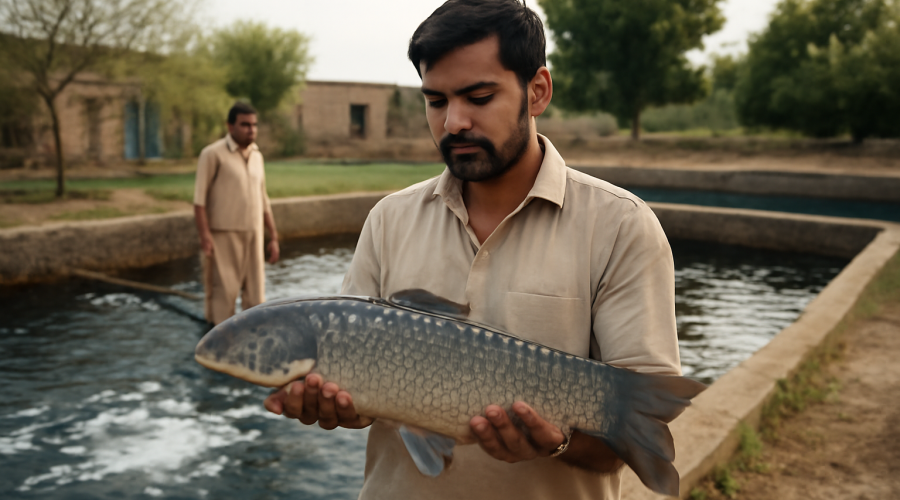
How to Start Fish Farming in Pakistan: A Beginner Guide
If you’ve got land near a canal, a tube well, or even just a few acres sitting idle, fish farming might be one of the more realistic small businesses you can build in Pakistan right now. The country has rivers, canals, barrages, and a coastline that together give it real potential for aquaculture, and the government has been pushing subsidies and training programs to get more people into the sector.
This guide walks you through what species to pick, how much money you’ll actually need, what a pond setup looks like, and where to go for help. We’ll also be straight about the parts that don’t get talked about enough, like disease risk, water testing, and how long it really takes before you see a return.
Why Fish Farming Makes Sense in Pakistan
Pakistan’s freshwater aquaculture mostly revolves around polyculture, meaning you raise several species together in the same pond because they feed at different depths and don’t compete for food. The most commonly farmed freshwater fish in Pakistan are the major Indian carps, Rohu, Catla, and Mori (also called mrigal). Catla feeds near the surface, Rohu in the middle layer, and Mori at the bottom, so a single pond can support all three without them fighting for the same food.
On a typical Pakistani farm, the species mix usually looks something like catla at 10 to 20 percent, rohu at 30 to 35 percent, mrigal at 15 to 20 percent, grass carp at 15 to 20 percent, and silver carp at 15 to 20 percent. Some farms also add a small percentage of channel catfish to the mix for extra diversity. One example from a Multan-based farm used silver carp at 35 percent, rohu at 25 percent, grass carp at 15 percent, mori at 20 percent, and channel catfish at 5 percent.
Tilapia has also become a serious option in the last decade. Punjab leads the country in freshwater species like rohu, while Sindh relies more on pond and tank systems, and Balochistan is developing marine aquaculture along the coast.
Choosing Your Fish: Carp, Tilapia, or Trout
Before you dig a single pond, decide what you’re farming, because it determines your location, your water source, your equipment, and your market.
Major carps (Rohu, Catla, Mori) are the safest bet for most beginners in Punjab and Sindh. Rohu has thick scales, a triangular head, and can reach up to a meter in length, though most farmed fish are harvested well before that size. Rohu fish are typically harvested once they hit at least 500 grams, but they command the best prices in the market once they reach 1 to 2 kilograms. The regular market price for Rohu sits around Rs. 300 to 450 per kilogram, though this fluctuates by region and season.
Tilapia is attractive because it grows fast and tolerates poorer water quality than carp. Areas with strong tilapia potential include Awaran, Khuzdar, Lasbela, and Sibi in Balochistan, and Bannu, Charsadda, D.I. Khan, Karak, Kohat, Mardan, Nowshera, and Swabi in Khyber Pakhtunkhwa, along with Hyderabad, Nawabshah, Sukkur, Shikarpur, and Thatta in Sindh. The Punjab market for tilapia is well established, with Gujranwala and Rawalpindi offering higher prices than other areas. As of 2026, retail tilapia prices in Islamabad and Lahore range between roughly PKR 1,094 and PKR 2,188 per kilogram, so there’s a decent margin if your production costs stay low.
Trout is a niche but profitable option if you’re in the north. Brown trout and rainbow trout are cultured in Khyber Pakhtunkhwa, Azad Jammu and Kashmir, and Gilgit-Baltistan, with around 738 kilometers of trout-bearing rivers, 8 state-run hatcheries, 18 private hatcheries, and 28 private trout farms producing an estimated 162,120 tons per year. Trout needs cold, clean, fast-flowing water, so this only works if you’re near a hill stream or spring source.
How Much Money You’ll Need
This is where most “how to start” articles get vague, so let’s get specific. Costs in fish farming swing wildly depending on scale, species, and how intensive your operation is.
The factors that move these numbers include the species you raise, whether land and water are already available to you, what equipment and infrastructure you need to install, and ongoing maintenance and feed costs. If you already own land with access to a canal or tube well, you can start at the low end of these ranges. If you’re buying land and drilling a bore, expect to be closer to the higher figures.
Keep in mind these are rough industry estimates from feasibility studies and farm advisories rather than fixed prices. It’s worth consulting a local fish farming expert or your provincial agriculture department before committing money, since actual costs vary a lot by project specifics.
Step by Step: How to Start Fish Farming in Pakistan
1. Pick your location based on water, not just land price
Your pond needs a reliable water source, whether that’s a canal, tube well, river, or natural spring. Test the water for pH, salinity, and contamination before you commit. Punjab’s saline and brackish water areas, for instance, are increasingly being developed for shrimp aquaculture because the water profile suits that species, which shows how much your location dictates what you can farm.
2. Decide on pond size and design
A standard stocking density for Rohu is around 8,000 to 10,000 fingerlings per hectare (about 2.4 acres). Most small farmers in Pakistan work with ponds in the range of half an acre to a few acres, built with earthen embankments and a controlled inlet and outlet for water management.
3. Source fingerlings from a reputable hatchery
For Rohu, you want fingerlings around 100mm in length and 10 to 15 grams in weight, reared from fry that started at 25mm. Expect a mortality rate of 10 to 20 percent between stocking and harvest, so order more fingerlings than your target headcount. Government hatcheries run by provincial fisheries departments are usually your most reliable and affordable source.
4. Prepare the pond properly before stocking
This means draining and drying the pond bed, removing predatory fish or insects, applying lime to adjust pH, and adding organic or inorganic fertilizers to kickstart the growth of natural food (plankton, algae) that fish feed on early in their cycle. The application rate of fertilizers depends on your farming intensity and the pond’s natural productivity, so it’s worth checking with your nearest fisheries office for specifics.
5. Stock your fish and start a feeding schedule
A common feeding rate used in research trials in Rawalpindi district was 3 percent of the fish’s wet body weight, given twice daily with a 12 hour gap, and adjusted weekly based on growth. In one comparison study, a commercial feed brand called Tokyo outperformed both a control of rice bran and another commercial feed called Miracle in terms of growth and feed conversion ratio, which tells you feed brand and quality genuinely matter, not just quantity.
6. Monitor water quality and fish health regularly
Watch for ammonia buildup, oxygen levels, and signs of disease. There have been reports of some Pakistani tilapia farms using poor feeding practices, including feeding livestock waste, which carries bacterial contamination risk and has drawn health concerns. Don’t cut corners here. A farm with a bad reputation for water quality or feed practices loses access to better buyers fast.
7. Harvest at the right size
Rohu is typically netted once it reaches at least 500 grams, but fish in the 1 to 2 kilogram range fetch the best prices. Plan your harvest timing around both fish size and market demand, since prices for fresh fish often spike around certain seasons and festivals.
What Profit Actually Looks Like
Let’s run through a real example using Rohu, since it’s the most farmed species in the country.
If you stock around 9,000 fingerlings per hectare (accounting for mortality from an initial 10,000) and they reach an average weight of 700 to 800 grams in 6 months, your total harvest weight comes to roughly 6,750 kilograms. At a wholesale price of Rs. 60 per kilogram, that’s a total return of Rs. 405,000, and after subtracting costs of around Rs. 270,200, the net profit works out to about Rs. 134,800.
That example is a few years old and wholesale prices have moved since, but the math structure still holds: your profit depends on survival rate, average weight at harvest, and the gap between your production cost per kilo and the price you sell at. Some farmers report earning around Rs. 100,000 per acre per year from a polyculture mix of rohu, catla, and mori, with potential to go higher depending on management.
Government Support and Subsidies
This is one area where Pakistan’s fish farming sector has gotten real attention recently, especially in Punjab.
Punjab’s government has announced an 80 percent subsidy for promoting fish farming, alongside plans for a saline water aquaculture research centre in Muzaffargarh, five thousand fish cages across barrages including Chashma, Taunsa, and Head Panjnad, and capacity building training for 750 fish farmers. The province has also been building fish nursery units in Darama, Gujja, and Jampur, and setting up a tilapia farm in Muzaffargarh.
For shrimp specifically, Punjab launched a CM initiative for shrimp aquaculture development costing Rs. 4,430.49 million over a 48 month period from 2024-25 to 2027-28, with subsidies of 75 percent of shrimp seed and feed costs (capped at Rs. 300,000 per acre) in the first season, dropping to 50 percent (capped at Rs. 200,000 per acre) afterward. Each participating farmer gets allotted five or ten acres, with applications processed on a first come first serve basis, though a lottery system is used if applications exceed available slots.
If you’re outside Punjab, check with your provincial fisheries department directly, since program details and eligibility change often and aren’t always reflected on national-level websites.
Where to Get Help and Training
The Pakistan Agricultural Research Council’s Aquaculture and Fisheries Program works on practical research that benefits small farmers too. One of their projects focuses on intensifying fish culture in farm ponds using better management inputs, with the goal of raising production from around 1,000 to 1,200 kilograms per acre to 1,800 to 2,500 kilograms per acre annually.
For business planning, SMEDA (the Small and Medium Enterprises Development Authority) publishes pre-feasibility studies that break down costs and revenue projections for different aquaculture models. These are free to download and give you a real financial framework rather than guesswork.
Provincial fisheries departments, like the one in Punjab, also offer fish seed through their hatcheries, soil and water testing, disease diagnosis support, and farmer training programs. Reach out to your nearest divisional office before you finalize your business plan.
FAQ
How much land do I need to start fish farming in Pakistan?
You can start with as little as half an acre to one acre for a small pond, though larger operations typically use multiple acres. Some government programs allot five to ten acres per farmer for larger shrimp or fish projects.
Which fish is most profitable in Pakistan?
Rohu remains the most widely farmed and consistently in-demand species, particularly in Punjab and Sindh. Tilapia is gaining ground because of faster growth cycles and lower feed costs, while trout offers higher per-kilogram prices but only works in cold, fast-flowing water in the north.
Do I need a license to start a fish farm?
Provincial fisheries departments handle licensing, inspection, and regulatory oversight for aquaculture. Punjab’s Department of Aquaculture and Fisheries explicitly covers licensing and compliance as part of its mandate, so contact your provincial department before you start construction.
How long until I see a return on investment?
For carp species like Rohu, a typical growth cycle to reach harvestable weight is around 6 to 8 months. Tilapia can grow faster. Trout takes longer due to colder water and slower metabolism. Your first full harvest is usually your first real revenue point.
If you’ve got access to water and a bit of land, fish farming in Pakistan is genuinely one of the more accessible agribusiness paths available right now, especially with the subsidy programs rolling out in Punjab. Start small, get your water tested, talk to your provincial fisheries department before you spend a rupee, and treat your first cycle as a learning run rather than a profit run.